LED Bathroom Mirror Buying Guide: Choose the Right Mirror

Choose an LED bathroom mirror based on your vanity width. Check wall space, lighting needs and safety rules. Dlinxcy Bathroom Vanity Buying Guide explains how to choose the bathroom vanity sets.
Are you a bathroom furniture factory, a builder, designer, hotel own, or wholesaler? Buying the wrong bathroom led mirror wastes time and money.
This complete LED bathroom mirror selection guide breaks down what to look. You will learn how to match your mirror size to your LED mirror for bathroom vanity. We also cover lighting, anti-fog tech, IP ratings, installation, and build quality.
What Should You Consider Before Buying an LED Bathroom Mirror?
Before buying an LED bathroom mirror, you need evaluate your application scenario. And measure real wall clearance, and build a precise specification checklist.
Define the Bathroom and Application
Different project types demand completely different LED mirror specifications. A single residential unit requires different features than a hotel build.
- Residential Retail & Private Label: Requires trendy designs, high CRI lighting, and retail-ready drop-test packaging.
- Hotel & Hospitality Projects: Needs commercial-grade durability, anti-fog pads, and simple maintenance.
- Apartment & Wholesale: Focuses on strict size standardization, bulk pricing, and repeatable re-order consistency.
- Bathroom Furniture Bundles: Demands exact color and finish matching with vanity cabinets.
Before sourcing, share your target market, application, quantity, and market with supplier.
Dlinxcy as a LED Bathroom Mirror Manufacturer and Supplier. You Can Consult They Experts.
Confirm Wall Space and Installation Conditions
Check these exact field conditions before finalizing your order:
- Total available wall width and vertical ceiling height
- Faucet spout height and mirror-to-counter clearance
- Hidden electrical wiring positions and junction box outlets
- Wall construction material and load-bearing capacity
- Choice between plug-in cords or hardwired connections
Prepare Your Pre-Purchase Specification
Providing complete LED bathroom mirror specifications can expedite the factory quotation process. For example:
| Specification Category | Details to Define |
| Dimensions & Shape | Width × Height, Rectangular, Round, Oval, or Arch |
| Frame & Lighting | Framed vs Frameless, Front-lit, Backlit, or Dual-lit |
| Electrical Core | Input Voltage, Color Temperature (3000K-6000K), CRI (90+) |
| Features & Safety | Touch Sensor, Motion Sensor, Anti-fog pad, IP Rating, Certifications (UL/CE/ETL) |
| Order Logistics | Order Quantity, Custom Logo, Drop-Test Packaging Requirements |
How Do You Match an LED Mirror With a Bathroom Vanity?
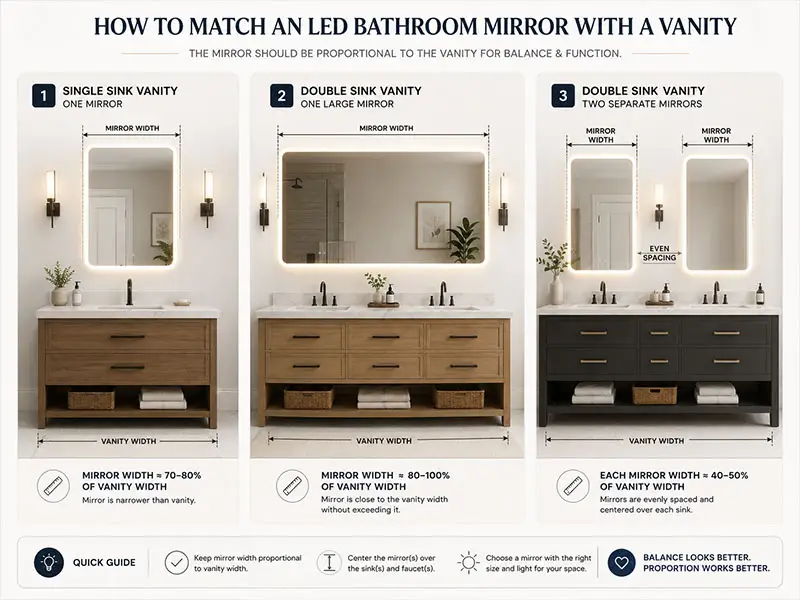
Matching LED mirrors with bathroom vanities. Mirrors should be 2 to 4 inches narrower than vanity tops. Keeping the light in the middle over the washbasin makes the room look visual balanced.
Selecting an LED mirror for bathroom vanity setups is not just about picking a pretty piece of glass. The mirror, basin, and cabinet must function as a single system.
Match the Mirror Width to the Vanity
The breadth of a bathroom mirror should never go beyond the margins of your vanity. For a balanced margin, trim 2 to 4 inches overall, or make the mirror width precisely match the vanity top.
Always factor in countertop overhang, basin centerline, and wall clearance. Leave at least 2 inches of breathing room between the mirror edge and adjacent walls. This prevents a cramped, boxed-in look.
For round or arched mirrors, measure both maximum width and usable reflective space. A 30-inch round mirror offers less actual viewing area than a 30-inch square mirror.
Single-Sink and Double-Sink Layouts
Single-sink bathroom vanities require one centered mirror. Double-sink vanities can have a single mirror or two separate mirrors. Ensure that each mirror’s center is directly below the sink basin’s center.
Single-sink vanity installation are simple. Center one mirror over the faucet, and you are done. Double sink bathroom vanities give you two distinct design paths:
| Layout | Advantages | Limitations | Suitable Projects |
| One Large Mirror | Creates a wide visual feel; unifies double vanity mirror size setups. | Harder to handle; expensive to replace if cracked. | Luxury real estate, master suites. |
| Two Separate Mirrors | Easier to ship; offers personal light control over each basin. | Requires dual electrical outlets and strict basin spacing. | Commercial hotels, multi-family housing. |
Four Double sink bathroom vanity: It’s easier to use two mirrors. A large custom mirror looks sleek, but the transportation and replacement costs are higher.
Coordinate the Mirror With the Vanity Style
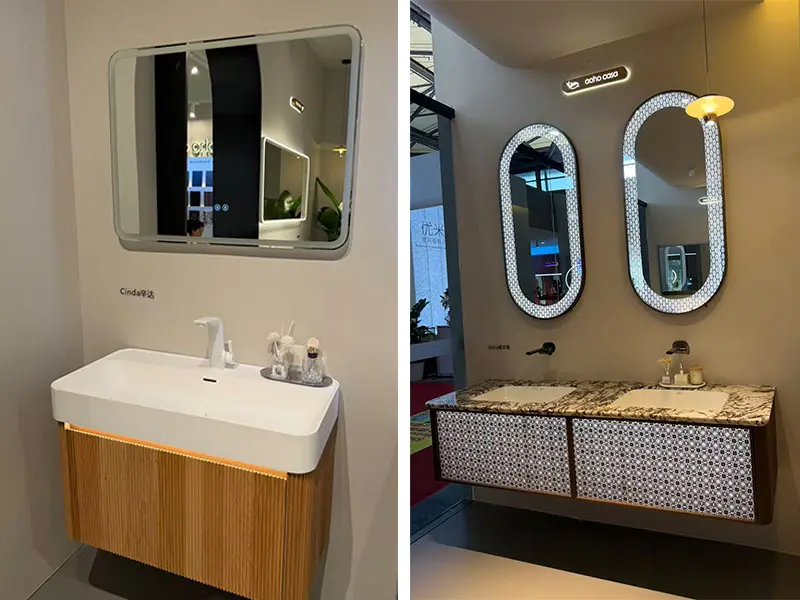
Maintain a consistent style in the bathroom. The finish and shape of the mirror frame should match the vanity hardware, faucet color, and cabinetry. A simple mirror can complement a more elaborate bathroom vanity. A framed mirror adds structure to a simple vanity.
Pick a frameless LED mirror if your cabinet features rich wood grain or marble. Round or arch LED mirrors break up hard angles in a vanity with flat, plain doors.
How to Choose the Right LED Bathroom Mirror Size
To choose the right LED bathroom mirror size, match the mirror width to your vanity dimensions. This maintains proper visual proportions.
Standard LED Bathroom Mirror Sizes
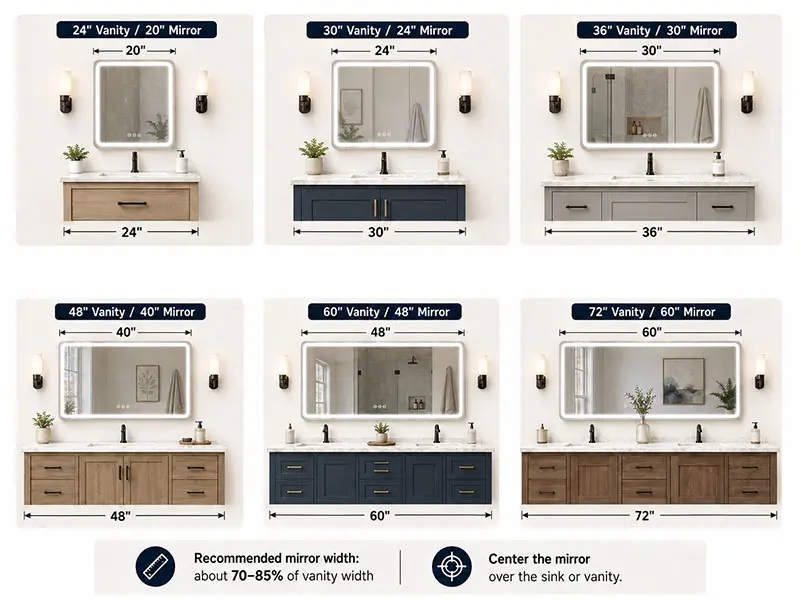
Most Standard LED mirrors sizes fall into a few common width ranges: 24, 30, 36, 48, 60, and 72 inches. But here’s the catch—those numbers only mean something when you match them to your vanity.
| Vanity Width | Typical Mirror Arrangement | Key Check |
|---|---|---|
| 24 inches | One 24-inch mirror | Center it exactly. Any offset looks sloppy. |
| 30 inches | One 30-inch mirror | Leaves about 3 inches on each side. Plenty. |
| 36 inches | One 36-inch mirror | Tight fit. Measure twice. |
| 48 inches | One 48-inch or two 24-inch mirrors | Depends on your sink layout. |
| 60 inches | One 60-inch or two 30-inch mirrors | Double sinks change everything. |
| 72 inches | One 72-inch or two 36-inch mirrors | Wide walls only. Don’t force it. |
If you’re ordering for a project, send your vanity drawing to Dlinxcy before you pick a size. By comparing it to your wall dimensions, they’ll ensure you don’t make a costly mistake.
One Large Mirror vs Two Separate Mirrors
With one wide mirror, a continuous, spacious design is achieved. A two separate mirrors, basin alignment is more clearly defined, and replacing the mirror is easier.
About One wide mirror:
- Expands visual space.
- It lights up the entire counter evenly.
- Increases transit breakage risks.
Two separate vanity mirrors:
- Easier to handle
- Low damage
- No fighting for Space
When to Choose a Custom-Size Mirror
If you have a non-standard vanity, a unique wall shape, or an exclusive brand, you can order a custom-sized LED mirror. Commercial building and hotlels often need custom bathroom mirror specs.
Before you go custom mirror, confirm these with your supplier:
- MOQ
- Drawings. They’ll need a detailed CAD or sketch.
- Sample approval.
- Dimension tolerance. Know the acceptable variance. Usually ±1mm.
- Packaging. Custom sizes need custom boxes.
- Lead time. Add 2-4 weeks to standard production.
How to Choose the Bathroom LED Mirror Shape and Frame?
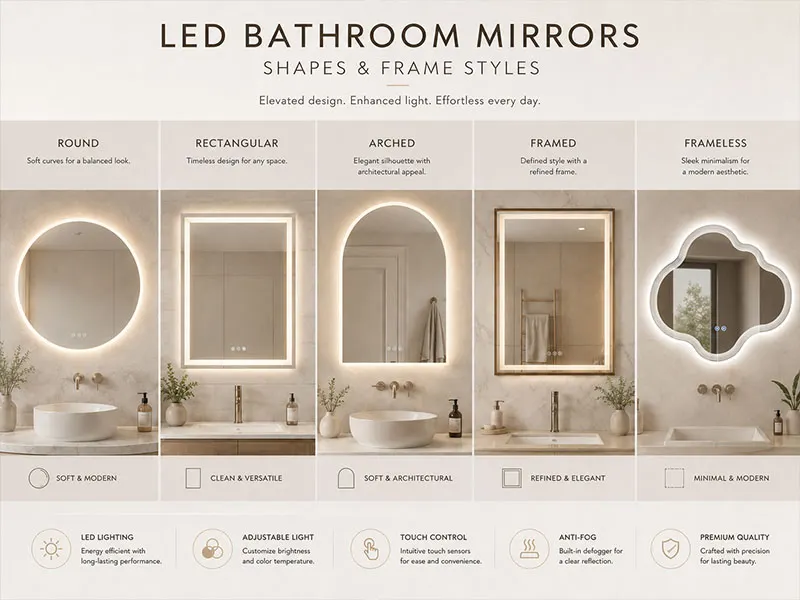
Your Bathroom LED mirror shape should match your design, viewing area, and hardware. Rectangular mirrors offer maximum viewing space. Round and custom shapes create strong visual effects.
Framed vs Frameless LED Bathroom Mirrors
Frameless mirrors deliver a sleek, floating look. The edges of framed mirrors are protected as well as the style is coordinated.
- Framed LED Mirror: You can choose different frame materials. Like aluminum, wood, stainless steel, and plastic material. It allows rich surface finish choices. like Matte Black, Brushed Gold, or Chrome plating.
- Frameless LED Mirror: With polished glass edges, these look clean and edge-lit. It’s lightweight and suitable for minimalist and modern interior designs.
Standard Shapes vs Custom-Shaped Mirrors
Common shapes include round, rectangle, and capsule-shaped. Standard shapes get you 90% of the way there. If you need different styles, need custom shape.
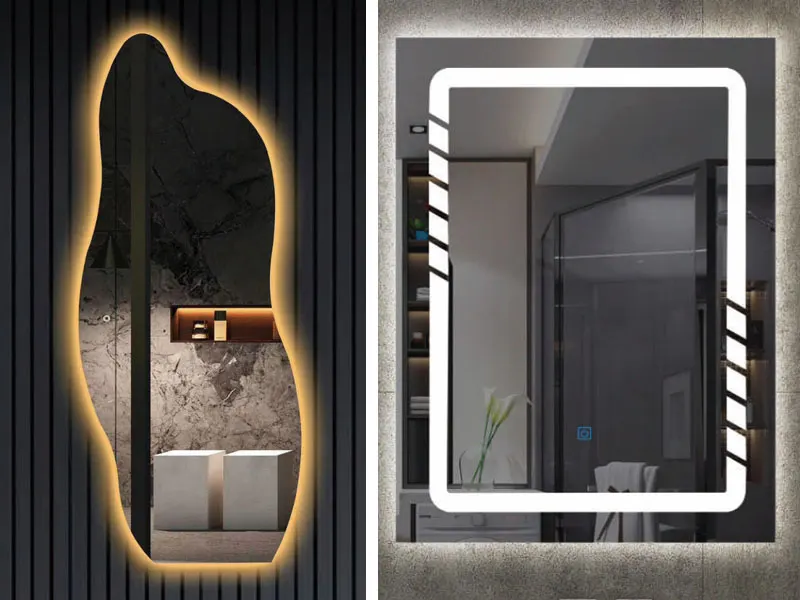
Custom shapes like arches, ovals, or irregular curves to create exclusive interior collections. Custom vanity mirror design turns a basic utility into a premium room feature.
- Oval. Soft and elegant.
- Arch. Adds height and drama.
- Rounded rectangle. The compromise. Modern but practical.
- Irregular shapes. Freeform. Bold. Hard to manufacture.
- Asymmetrical. Left side different from right. High-end residential only.
How Do You Evaluate LED Bathroom Mirror Lighting?
To evaluate LED bathroom mirror lighting – need test light direction, color temperature, CRI rating, and memory. The right light setup provides clear face illumination without casting harsh shadows.
Front-Lit vs. Backlit LED Bathroom Mirrors
They have 3 style lightings. Each does something different. Fronlit, backlit, and Backlit and front-lit combination.
- Front-lit: Light comes from the front edge, pointing toward you. Straight to your face. No shadows.
- Backlit: Light glows from behind the mirror. It hits the wall first, then bounces back. Soft. Ambient.
- Front-lit and backlit: Both at once. Best of both worlds. You get direct face illumination and a halo effect on the wall.
| Lighting Structure | Primary Benefit | Shadowing Effect | Best Application |
| Front-Lit Mirror | Direct forward task lighting | Minimal facial shadows | Daily grooming, vanity makeup |
| Backlit Mirror | Soft ambient wall glow | Higher facial shadows | Hotel mood lighting, powder rooms |
| Front & Backlit | Full brightness + wall glow | Zero facial shadows | Luxury master baths, premium suites |
Note: Don’t just pick the most expensive option. Pick what fits your market. Hotel projects love backlit for ambiance. Residential bathrooms need front-lit for function.
Color Temperature (CCT)
Color temperature alters the warmth or coolness of mirror light. Preferred CCT levels vary widely across global markets and interior styles.
- 3000K (warm white): Yellowish. Cozy. Hotel spas love this.
- 4000K (neutral white): The sweet spot. Balanced. Most versatile. Good for both makeup and ambient.
- 5000K–6000K (cool white): Bluish. Harsh. Clinically bright.Shows every imperfection.
Adjustable CCT lets you switch between color temperatures with a touch. We recommend choosing a mirror with adjustable color temperature.
Brightness and Color Rendering Index (CRI)
Don’t just look at the wattage rating to decide how bright a mirror is. LED strip density, diffuser plate quality, placement of the light, mirror size, and driver output determine total light output.
CRI (Color Rendering Index) measures how accurately the light shows true color. For true makeup lighting, require a CRI > 90. High CRI produce accurate skin tones without strange color casts. The low CRI of a light distorts colors and strains the eyes.
The U.S. Department of Energy’s LED Basics provides additional guidance on CRI and LED color quality.
Dimming and Memory Functions
In the event of power cuts, continuous dimming and smart memory maintain the user’s settings. As opposed to step dimming, continuous dimming allows light levels to be adjusted smoothly over time. Memory functions including color, brihtmess and power-off.
Choose the Right LED Mirror Features
Choose LED mirror features based on your need rather than simply stacking electronic add-ons. More features mean higher costs.
Anti-Fog and Demister Functions
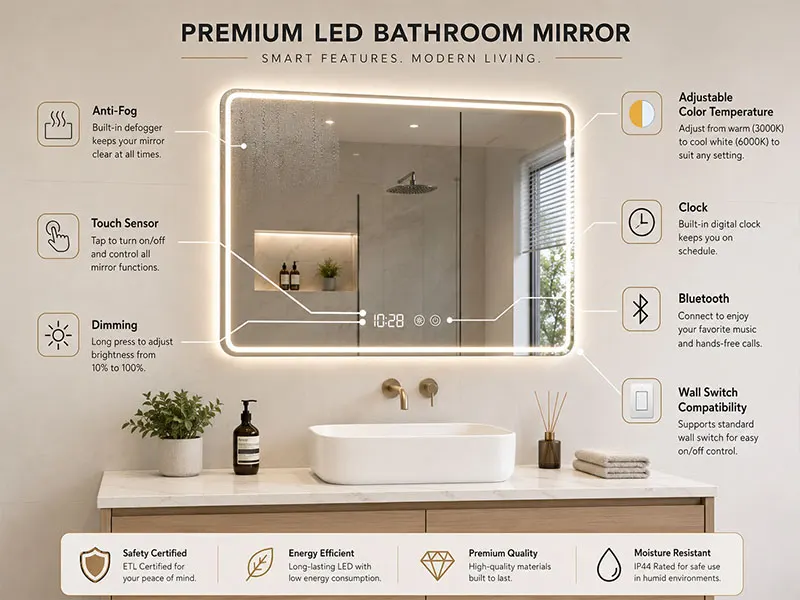
An anti-fog LED mirror uses a heated demister pad behind the glass. It heats the surface just enough to stop condensation from forming. After a hot shower, you no longer need to face a foggy mirror.
When evaluating a demister pad, check heating speed, power draw, and surface coverage. It’s ideal for hotels and families. It can enhance the hotel guest experience and increase positive reviews.
Touch Sensor
Touch sensors offer sleek glass operation. Just a light touch of your finger on the mirror surface. Always test sensor switch sensitivity with wet hands during sample reviews.
Adjustable Color Temperature
Adjustable color temperature adds retail appeal for premium lines. A three-color LED mirror switches between 3000K, 4000K, and 6000K with brief button taps.
Clock, Bluetooth, and Smart Features
Smart add-ons create marketing highlights. Evaluate smart features against actual buyer demands:
- Digital Clock & Temp Display: People can see the time and temperature when they look in the mirror.
- Bluetooth Mirror: It can connect to your phone via Bluetooth to listen to music and podcasts anytime.
- Shaver Socket & USB Ports: The USB charging port can charge your phone and shaver.
- Motion sensor: Mirror turns on when you walk in. Turns off when you leave.
- Magnifying mirror: Add a magnification function to a section of the mirror, like 3x, 7x, or 10x. This makes it easier to apply eyeliner and false eyelashes for more precise makeup.
IP Rating, Safety and Installation Requirements
The electrical safety of LED mirrors is considered from three aspects. IP waterproof rating, market certification, and proper wiring and installation.
Led Mirrors for Bathroom IP Ratings
An IP rating tells you how well a cover stops splashes of water and steam. IP44 is the standard for use in the bathroom. Splash-proof. It won’t be hurt by water coming from any way. With IP54, you can protect against dust.
You can review the IEC ingress protection (IP) ratings before confirming the mirror specification.
Certifications
Different markets need differ certifications. Europe wants CE. Different markets need differ certifications. Europe wants CE. North America and UK need UKCA, ETL, UL, ROHS now.
If you want to create a high-quality brand mirror, these certification is need. Buyers are willing to pay a premium for them.
Reference: Official EU CE marking requirements, UK guidance on UKCA and CE marking
Hardwired vs. Plug-In Installation
Two ways to power a mirror. Hardwired Or plug-in. Hardwired mirrors provide an invisible connection for commercial builds. Plug-in mirrors offer fast setup for retail buyers.
- Hardwired LED Mirror: Connects directly into a recessed junction box, hiding all LED mirror wiring.
- Plug-In LED Mirror: Plugs into a standard wall outlet. It simplifies retail home installation but leaves a visible power cord.
Choose an LED Mirror or LED Mirror Cabinet?
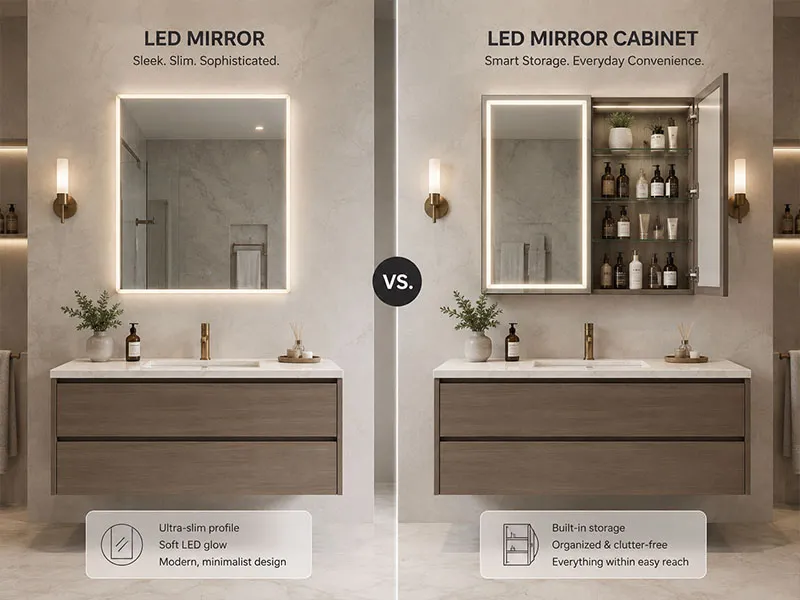
Choose an LED bathroom mirror for a slim, decorative wall profile. Pick an LED mirror cabinet if your space requires hidden storage.
When to Choose an LED Bathroom Mirror
Go with a flat mirror when your bathroom already has storage. Built-in shelving. A cabinet elsewhere. A vanity with drawers. You don’t need more boxes on the wall.
You want a clean, minimal look. A flat mirror is just glass and light. Nothing else. That simplicity looks expensive. Especially in modern or Scandinavian design.
Weight matters. Flat mirrors are lighter. Easier to mount. Less wall support needed.
When to Choose an LED Mirror Cabinet
It not only functions as a mirror, but also increases your storage space. Choose a LED mirror cabinet when storage is tight.
If Bathrooms are small. Counters get cluttered. Toothbrushes. Creams. Razors. Hair products. Cabinets solve that. Everything goes behind the door. Bathroom looks tidy.
Storage, Installation, and Cost Comparison
No format is universally better; room layout and project budget determine which is best. Compare:
| Factor | LED Bathroom Mirror | LED Mirror Cabinet |
| Storage Capacity | None (surface glass only) | High (multi-tier internal shelves) |
| Product Depth | Slim (20mm – 45mm wall profile) | Deeper (120mm – 150mm wall profile) |
| Weight & Mounting | Lightweight; standard wall anchors | Heavy; requires solid wall studs |
| Product & Shipping Cost | Lower base unit and freight cost | Higher unit cost and shipping volume |
If your vanity features large lower drawers, choose a flat LED mirror. If counter space is tight and extra storage is needed, pick a mirror cabinet.
LED Bathroom Mirror Need Change by Buyer Type
Different buyer types require completely different LED mirror specifications, packaging standards, and supply chain. Your business type determines your mirror model. Not the other way around.
Brand Owners and Private-Label Buyers
Private-label brands need unique product styling, custom retail packaging. Your product need standing out in retail channels.
Here’s what to prioritize:
- Product differentiation: Shape, Frame finish, Lighting style and more.
- Private-label logo: Laser-etched or Screen-printed.
- Packaging: Branded boxes. Custom inserts, foam with your logo.
- SKU range: Entry-level to premium. A complete lineup.
- Market positioning: Are you budget? Mid-range? Luxury?
- Sample: The first sample always needs revisions.Need fast pre-production sample.
Refer to relevant ISTA package-testing procedures
Bathroom Vanity and Furniture Manufacturers
Your mirror must pair with your vanity cabinets. Color. Size. Finish. Design language. Assemble together as a unified bathroom furniture collection.
Here’s what to prioritize:
- Size matching: The mirror should sit proportionally above your vanity.
- Frame finish coordination: Match the mirror frame to your cabinet hardware.
- Container loading: Can the mirror ship in the same container as your vanities?
- Batch-to-batch consistency: Production runs months apart should look identical.
Here’s a real example. A bathroom furniture fatory brand developed 32 vanity collections. Each had different hardware finishes—matte black, brushed brass, and chrome. Dlinxcy matched every mirror frame to the correct finish.
Hotels, Builders, and Commercial Property Projects
Hospitality and construction projects prioritize commercial durability, strict certifications, and floor-by-floor job-site logistics. Project buyers need standardized SKUs that simplify long-term property maintenance.
Key commercial project requirements include:
- Verified ETL, UL, CE, or UKCA safety certification files
- Room-by-room carton labeling for fast job-site sorting
- Staged container delivery schedules tied to construction milestones
- Guaranteed long-term spare driver and LED part availability
Wholesalers, Distributors, and Interior Designers
Wholesalers focus on container load efficiency and fast-moving SKUs. Interior designers demand custom shapes and precise CAD support. We serve both commercial supply channels:
- Wholesalers & Distributors: Require low MOQs, high container packing density, durable transit packaging, and repeatable re-order quality to maximize stock turnover.
- Interior Designers: Require custom-shaped LED mirror capabilities, dynamic CCT tuning, custom metal finishes, and rapid CAD drawing validation.
Conclusion
Choose the right LED Bathroom mirror without costly mistakes. Follow this sequence and you’ll get it right.
- Confirm Vanity & Wall Space: Measure wall clearance and sink centerlines.
- Determine Size & Shape: Select mirror proportions that balance your cabinet width.
- Select Lighting & Features: Choose light direction, color temperature, and demister pad sizes.
- Verify Safety Compliance: Confirm local voltage, IP water ratings, and electrical certifications.
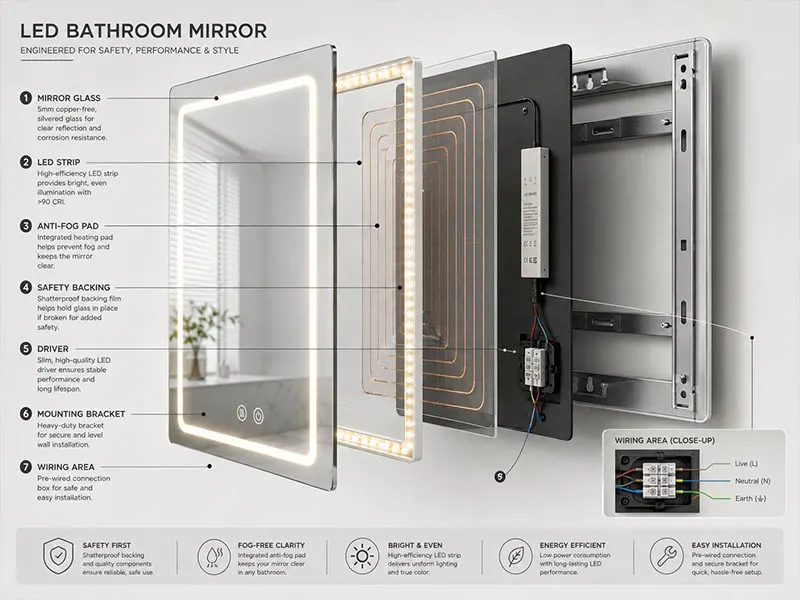
- Inspect Build Quality: Check copper-free glass backing, LED driver stability, and drop-test packaging.
- Sign Off on Production: Approve physical samples, CAD drawings, MOQ terms, and factory lead times before placing bulk orders.
Dlinxcy is a bathroom vanity manufacturers. We produce bathroom cabinets, LED bathroom mirrors, and mirror cabinets. Contact Us to Get Your Solutions.
Read Related Article:
Send Inquiry To Dlinxcy Experts