Best Material for Bathroom Vanity Cabinet: Buying Guide

Pick the wrong bathroom vanity cabinet material. You will face swollen doors, rusted hinges, or a cracked countertop. For most bathroom vanity projects, plywood is the best overall cabinet material. PVC material works better in bathrooms with heavy moisture or poor ventilation. Sintered stone suits premium projects that need a hard, water-resistant surface.
This guide compares plywood, PVC, sintered stone, and MDF across eight performance metrics. It can help you make the right choice. Whether it used in hotels, apartments, residences, villas, or public commercial restrooms.
If you want know more, pls read related article: Bathroom Vanity Buying Guide for Projects.
What Is the Best Material for Bathroom Vanity Cabinets?
For most bathroom vanity projects, no material fits every project. Plywod is popular. PVC can 100% whaterproof. Sintered stone more hard and water-resistant surface. MDF can control cost. You need to choose the right materials based on your usage scenario and cost.
Moisture-Resistant Plywood Material
Moisture-resistant plywood is often the best material for bathroom vanity cabinets. Because it combines strength, stability, and design flexibility. Bathroom vanities manufacturers make it buy cross-laminated hardwood veneers. This cross-layer structure helps the board resist bending and warping.
The drawer slides and hinges stay in place even after being used many times. A bathroom-grade plywood cabinet needs sealed edges and a surface finish. It costs more than basic MDF.
PVC for High-Humidity Bathrooms
PVC materials with constant humidity, frequent splashes, or poor ventilation. It’s the closest thing to a 100% waterproof carcass on the market. More lighter and surface is easy to clean. Screws can only be tightened once; once loosened, they cannot be tightened back in the same position.
Sintered Stone Material
Sintered stone is forged from natural clays and feldspar under intense heat over 1200°C.
Non-porous surface with water absorption below 0.02%. It has a high water resistance, strong scratch resistance, and premium appearance. Sintered stone is highly sought after in premium hotels, villas, and high-value projects by designers.
MDF Material
Medium-density fibreboard (MDF) uses urea-formaldehyde glue to squeeze wood fibres together. Its smooth, even surface works great with paint, veneer, and thermofoil. It’s still not waterproof. Once the core absorbs water, it may swell and lose strength. It’s usually used in a bathroom with separate wet and dry areas.
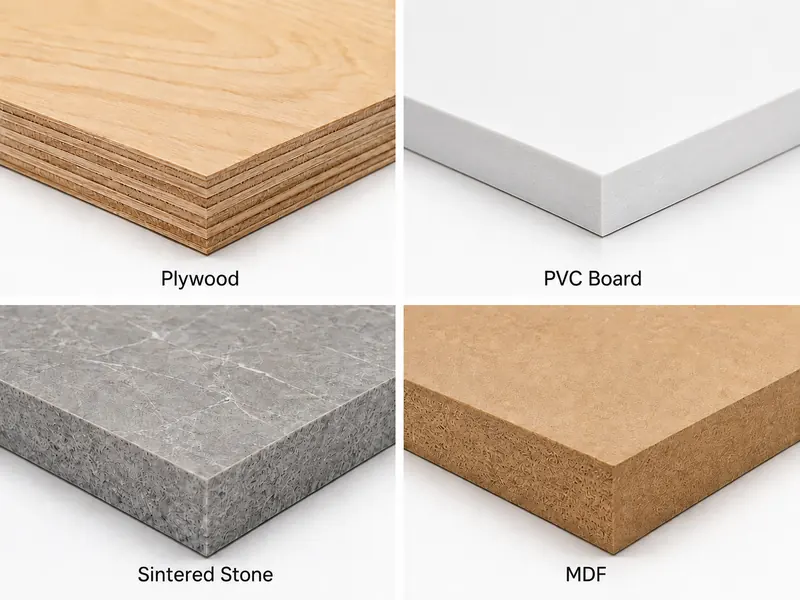
Bathroom Vanity Cabinet Material Comparison
The four main types of bathroom vanity cabinet elements are shown below in a table. Performance relies on the type of material, panels thickness, finish, edges sealed, hardware, and cabinets structure.
| Factor | Plywood | PVC | Sintered Stone | MDF |
|---|---|---|---|---|
| Water Resistance | About 90% waterproof with sealed edges | 100% waterproof. Does not soak water | Excellent waterproof | Low. About 50% waterproof |
| What It Is Made Of | Thin wood veneers bonded in cross-grain layers | Rigid or foamed PVC board. | Mineral powders pressed and fired at high temperature; | Wood powder pressed with glue |
| When It Gets Wet | May swell or delaminate if water reaches unsealed inner layers | Usually stays flat, but joints and hardware points still need protection | Does not swell; edges may chip under impact | Can swell, soften, or lose strength if water enters the core |
| Structure and Density | 0.55–0.70 g/cm³. Layered, strong, stable | 0.60 g/cm³ Uniform and lightweight | 2.40–2.60 g/cm³. Dense, hard, rigid | Smooth and dense, with good machining stability |
| Weight | Medium | Light | Heavy | Medium to heavy |
| Safety | ENF, E0, or E1 grade plywood. coating safety, and formaldehyde test reports | Check material grade, additives, flame performance, and compliance reports | Low emissions; safe handling and strong installation remain important | Check formaldehyde emissions, paint, resin grade, and market compliance |
| Best Use | Hotels, apartments, private-label ranges | High-humidity bathrooms, rental projects, humid climates | Luxury hotels, villas, premium design projects | Dry-area storage, decorative interiors |
| Project ROI | Strong overall ROI due to durability, hardware stability, and broad design use | Good ROI in wet markets, but weak boards may need reinforcement | High initial cost with strong premium value and low surface maintenance | Lower starting cost, but water damage may raise replacement risk |
What Does Bathroom Vanity Cabinet Material Include?
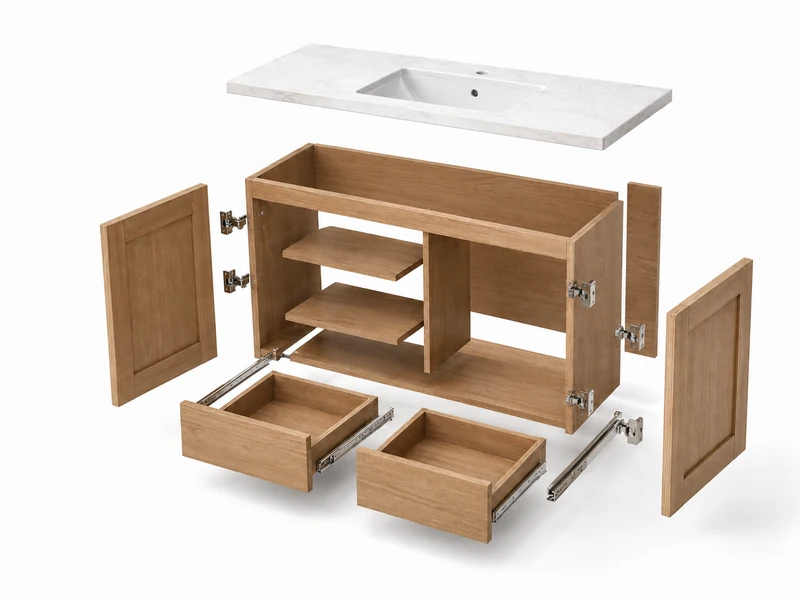
A vanity cabinet is not a single slab. It is an assembly of different components. Like cabinet body, doors, drawers, and back panels, finish, countertop and basin. These parts do not always use the same material. You can mix and match according to your needs.
Cabinet Carcass, Doors, Drawers and Back Panels
The cabinet carcass forms the main structure of the bathroom vanity. It includes the side panels, bottom panel, top rails, shelves, and internal supports. The carcass support the weight of the countertop, basin, drawers, and stored items.
The doors and drawer fronts affect the look of the vanity cabinet. You can choose door, drawer, or a combination of both. Using drawers would increase costs.
Back panels often receive less attention, but they face plumbing leaks and wall moisture. Thin or poorly sealed back panels can swell first. Buyers should check the back panel material, thickness, ventilation openings, and pipe cutouts.
Core Material vs Surface Finish
Two terms confuse procurement buyers: core and surface finish. The core is the structural board beneath everything—plywood, PVC, or MDF. The surface finish is the skin: paint, melamine paper, thermofoil, PET film or wood veneer.
For example, two white painted vanity cabinets may look the same in a showroom. One may use moisture-resistant plywood. The other may use standard MDF.
A waterproof surface does not make the full cabinet waterproof. Water can enter through hinge holes, plumbing cutouts, damaged edges, and panel joints. Once water reaches the core, the material controls how the cabinet reacts.
Countertop Material
The countertop sits above the cabinet and supports the basin. It faces water, soap, cosmetics, heat, and daily cleaning. Countertop materials has sintered stone, quartz, engineered marble, or integrated ceramic.
Heavy countertops need a strong cabinet body. Wide quartz or sintered stone tops need metal brackets or reinforced side panels.
Cabinet Basin Material
Ceramic basin is common. because it is hard, easy to clean, and resistant to stains. If you want look preminum, can use integrated sintered stone basins.
There are three types of basins: under-mount, top-mount, interagted. The type of basin changes how the cabinet looks. Top-mount basins are on top and have an edge that points up. To fit an undermount basin, the countertop needs to be strong and have an exact cutout. An integrated basin can make cleaning easier.
What to Consider When Choosing Bathroom Vanity Cabinet Materials
Cabinet materials should be selected based on the bathroom environment, cabinet size, hardware, finish, and target market. Don’t get sucked into surface beauty when shortlisting materials. The cost of repairing, warrantying, and replacing weak material can be higher.
Moisture and Water Resistance
Bathrooms cabinets to steam, splashes, leaks, and wet cleaning. Need considered bathroom environment. If commercial and public washroom, advice use sintered stone top.
PVC is better at keeping water out than plywood. When the factory seals all the edges and cutouts, plywood works well. Surface protection for MDF needs to be better.
Structural Strength and Load Capacity
The cabinet must support the countertop, basin, drawers, and stored items.For wide cabinets with two sinks, the bars and side walls need to be strong. Tops made of heavysintered stone or quartz tops might need metal supports or boards that are thicker.
Screw-Holding Strength and Hardware Stability
Hinges, drawer slides, brackets, and connectors depend on firm screw holding. Plywood usually holds screws better than MDF and many PVC boards. Weak fixing points can loosen after repeated use. For hotel and rental projects, ask the factory to test hinges and drawers under repeated opening cycles.
For repeatable cabinet testing, buyers can refer to ISO 7170:2021 for bathroom furniture storage units, which covers test methods for strength, durability, and stability.
Swelling, Warping and Dimensional Stability
Swelling and warping are not the same failure. Swelling is thickness increase—edges puff up like sponges. Warping is a shape change—doors bow outward or twist into spirals.
A panel may look strong when dry but change after months of humidity. MDF can swell when water enters the core. Solid wood may expand or shrink. Plywood stays more stable because of its cross-layer structure. PVC does not swell like wood, but low-density boards may bend under load.
Surface Finish and Edge Sealing
Paint, laminate, thermofoil, veneer, and melamine protect the core and shape the final look. The weakest areas are often exposed edges, drilled holes, joints, and plumbing cutouts. A good finish must cover these points. Clean edges and sealed cutouts often matter more than a polished front surface.
Maintenance and Expected Service Life
Painted MDF needs dry edges and quick spill cleanup. Plywood needs sound sealing. PVC needs fewer moisture-related repairs but may show dents or heat damage. Service life depends on material grade, finish quality, ventilation, cleaning, and daily use.
Emissions and Market Compliance
Board materials, adhesives, paints, and coatings may release formaldehyde or other compounds. Ask for test reports that match the target market. Plywood and MDF may carry ENF, E0, or E1 grades. Buyers may also need documents for REACH or other local rules.
For products sold or imported into the United States, hardwood plywood and MDF may fall under the EPA formaldehyde emission standards for composite wood products under TSCA Title VI.
Plywood Bathroom Vanity Cabinets
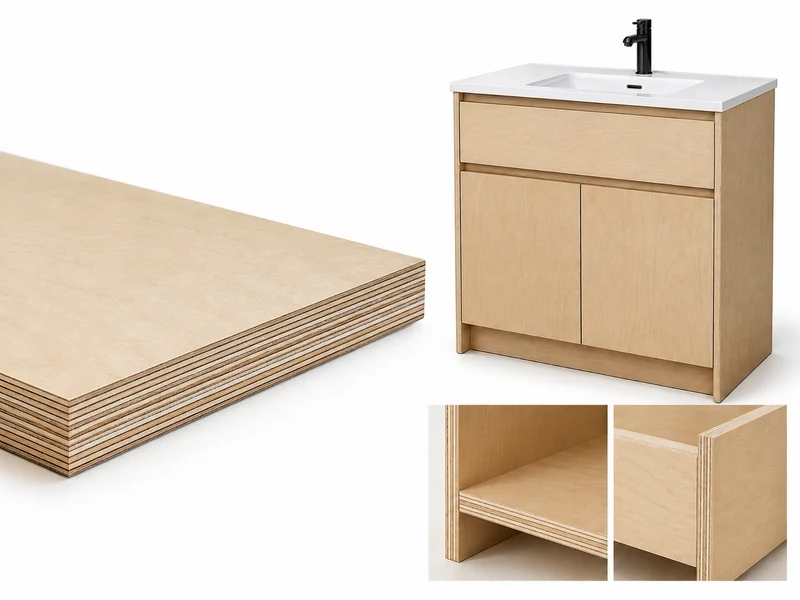
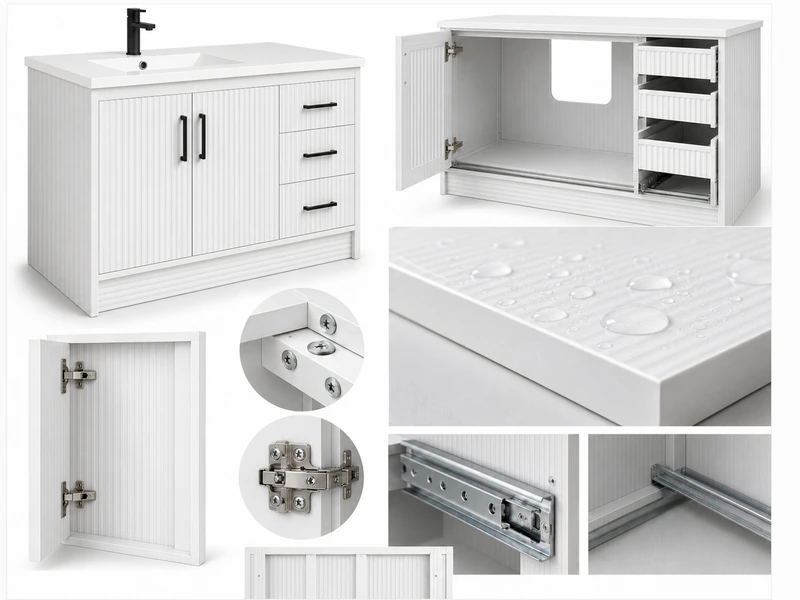
One of the most useful materials for bathroom vanity cabinets is plywood. It provides dependable screw gripping, constant proportions, and good strength. When the factory seals the edges, plywood bathroom vanity cabinet can handle daily humidity and water splashes well.
How Plywood Is Constructed
Plywood consists of thin wood veneers bonded in layers. The grain direction changes from one layer to the next. These veneers are stacked in layers with odd numbers (11 or 13 plies). Although having more layers can increase stability, quality cannot be determined only by the number of layers.
The USDA Wood Handbook on wood-based panels explains how veneer quality, layer arrangement, adhesives, and bonding conditions affect plywood performance.
Moisture Resistance and Dimensional Stability
Plywood’s structure gives it a advantage: uniform expansion. When humidity rises, each veneer layer swells in its grain direction. It usually keeps its shape when bathroom humidity rises and falls.
Strength and Screw-Holding Performance
Because fasteners grasp multiple layers of wood, plywood retains screws well. This makes the wall brackets, drawer slides, and hinges more sturdy.
Available Finishes and Customization
Plywood main has two types surface finishes. Including melamine and natural wood veneer. You can match the finish to the target price, design style, and maintenance needs. Natural veneer creates a wood look. Melamine finish is cost-effective and scratch-resistant.
Best Applications for Plywood Vanities
The best material for projects requiring strength, moisture resistance, and design flexibility is plywood. Vanities, hotel rooms, apartment projects, and high-end private-label collections are all good places to use it.
PVC Bathroom Vanity Cabinets
PVC bathroom vanity cabinets work well in wet spaces. It stays stable around steam, splashes, and damp floors. It’s a good choice for bathrooms with weak ventilation or daily water exposure.
How PVC Bathroom Cabinets Are Made
PVC bathroom cabinets start with extrusion foaming. PVC resin mixed with stabilizers, lubricants, and a foaming agent, then forced through a heated die. The result is a cellular plastic board with a uniform honeycomb interior and a denser surface.
Waterproof and Moisture-Resistant Performance
A PVC cabinet can sit in standing water for 24 hours and emerge unchanged. No edge swelling. No delamination. No warping. Joints and hardware still need care.
Surface Finishes and Design Options
PVC boards adopts baking paint or Films. Suitable for creating surface flunted designs.
Best Applications for PVC Vanities
PVC works best in wet bathrooms where moisture control matters more than heavy load capacity. It suits rental projects, apartments, compact vanities, and humid markets.
Sintered Stone Bathroom Vanity Cabinets
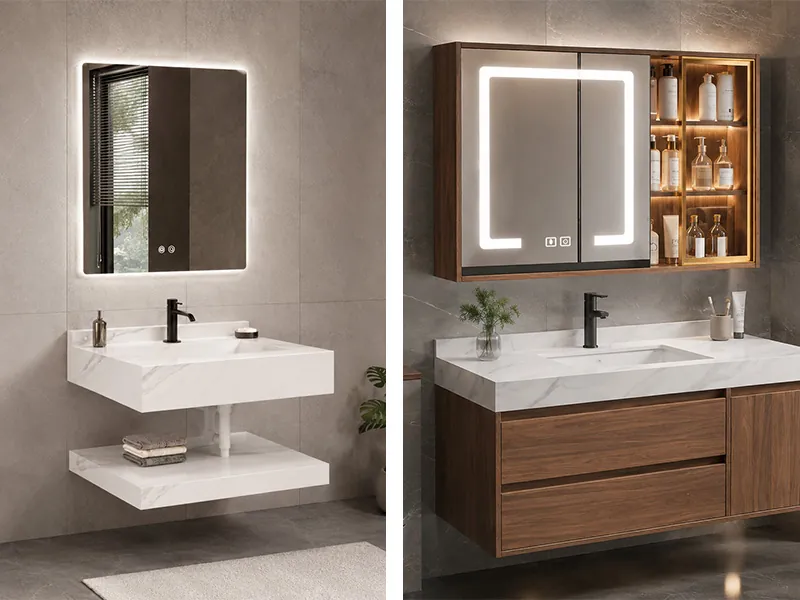
Sintered stone represents the premium bathroom vanity design. It delivers unmatched scratch resistance, zero water absorption, and a surface that withstands heat, chemicals, and heavy use.
Full Stone Cabinets vs. Hybrid Builds
Standard industry setups pair a stone top with a plywood or MDF cabinet body.
A full sintered stone bathroom vanity uses zero organic material on the outer shell..
- Water and Humidity Immunity: Sintered stone absorbs no water. It will not warp, peel, or sag in steam.
- Visual Continuity: Side panels, drawer fronts, and top surfaces share the same pattern, texture, and sheen.
- Chemical Defenses: Harsh bathroom cleaners, bleach, and hair dyes will not stain the stone.
| Feature | Full Sintered Stone Cabinet | Stone Top + Conventional Base |
| Primary Shell Material | Sintered stone on metal frame | Plywood, MDF, or solid wood |
| Moisture Resistance | Zero water absorption | Low (susceptible to swelling) |
| Lifespan | Decades without surface damage | 5–10 years in humid rooms |
| Structural Weight | High (requires solid mounting) | Moderate |
| Fabrication Complexity | High (CNC cutting, mitered joins) | Standard woodworking |
Projects That Justify the Cost
Building a premium bathroom vanity from stone costs more money. Shipping and handling also cost more. The fabrication process involves precision CNC cutting and mitered edge joining. Specialized crates protect the slabs during transport.
Three project types justify this extra cost:
- Luxury Residential Master Suites: Homeowners want seamless designs. The vanity matches surrounding stone wall panels.
- Five-Star Hospitality Properties: Hotel bathrooms need tough fixtures. Stone stands up to daily cleaning teams and constant steam.
- High-End Commercial Restrooms: Public venues need fireproof and scratch-proof surfaces. Stone looks new after years of heavy use.
How Surface Finishes Affect Cabinet Performance
Surface Finishes affect waterproofing, corrosion resistance, and appearance.
Painted and Lacquered Finishes
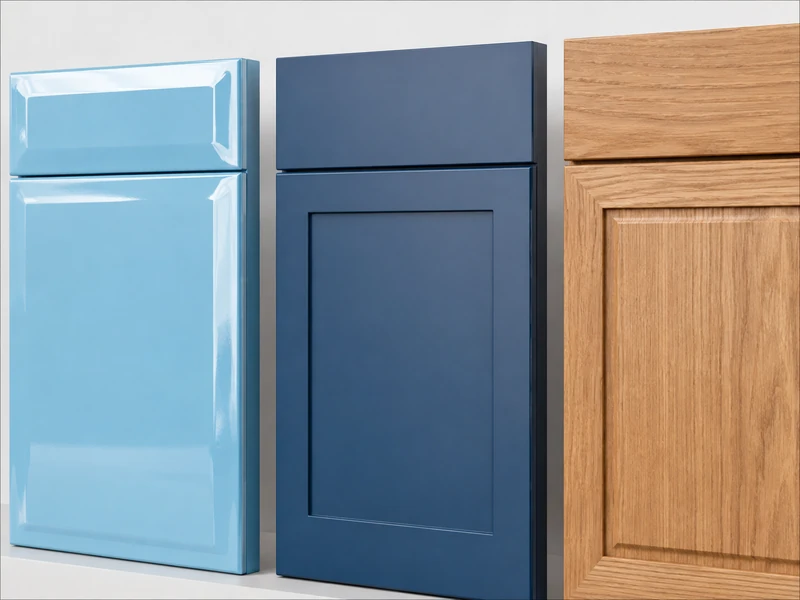
A painted vanity cabinet offers rich color and a sealed surface. Paint wipes clean. It supports matte, high-gloss, and custom colors.
Paint also carries risks. Corners often receive thin coats. Door joints can crack over time. Hard impacts chip the paint and expose the core. Colors can also vary between production batches.
Buyers must inspect five critical quality items:
- Coating thickness
- Color tolerance
- Adhesion strength
- Edge coverage
- Curing quality
Thermofoil on MDF
A thermofoil bathroom vanity uses heat to wrap a PVC film over an MDF core. Thermofoil is a coating, not a core material.
The film forms a continuous surface. It resists dirt, wipes clean, and offers realistic wood grains. Costs remain low.
Heat poses the main risk. High temperatures cause peeling. Corners suffer from weak glue bonds. If the film tears, the MDF core swells from moisture. Repairs remain difficult.
Thermofoil improves surface water resistance, but it does not turn the MDF core into a waterproof board.
Melamine and Laminate Finishes
A melamine bathroom cabinet uses a thin paper layer soaked in resin. A laminate vanity uses a thicker surface layer. Laminate offers higher scratch resistance. Melamine keeps production costs lower.
Both options depend on tight cabinet edge sealing. Surface waterproofing does not mean cutout waterproofing.
Procurement teams must check five factory standards:
- Surface scratch resistance
- Glue bonding strength
- Edge banding tightness
- Corner alignment
- Grain and color consistency
Natural Wood Veneer
A wood veneer bathroom cabinet delivers real timber texture. The thin wood layer still needs a solid core, protective topcoats, and moisture treatment.
Natural grain and color variation create beauty. Yet, this natural variance brings risk to bulk projects.
Brands and interior designers must confirm four specifications during sampling:
- Veneer species
- Grain direction
- Stain color
- Acceptable color variation
Edge Banding and Exposed Cutout Sealing
Edge sealing protects the cabinet core from destruction. Water enters through seven weak points:
- Door edges
- Drawer edges
- Hinge holes
- Plumbing cutouts
- Faucet holes
- Back panel cuts
- Board joint seams
Bad edge sealing ruins high-grade boards. A vanity may pass a surface splash test, yet swell around the basin cutout months later because the exposed core was never sealed. Unprotected drilled holes draw moisture deep into the board.
What Affects Bathroom Vanity Cabinet Cost?
Materials, panel thickness, surface polishing, hardware brand, and packaging format can all affect the price.
Core Material Grade and Panel Thickness
Different materials have different prices. Panel thickness each millimeter adds roughly 8–10% to the raw board cost. The gap between 15mm and 18mm plywood is not just 3mm—it represents a 25–30% material cost increase for the cabinet material.
Surface Finish and Edge Treatment
Surface treatments directly drive labor costs and factory yield. Multi-coat lacquer paint requires dust-free spray rooms, manual sanding, and extended curing times. High-gloss finishes demand flawless polishing.
Real wood veneers and thick PUR edge banding raise material costs. Complex edge sealing and mitered corner joins increase labor time and rework risks during production.
Hardware and Internal Structure
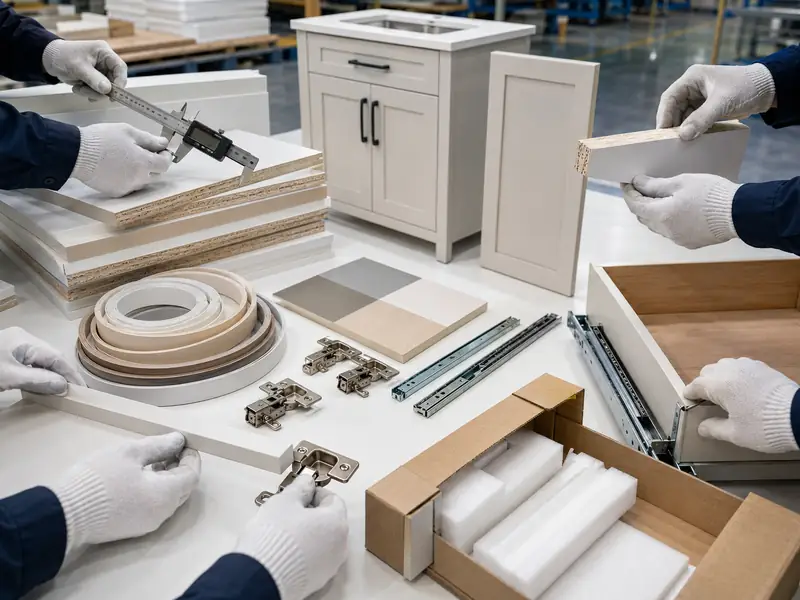
Hardware quality dictates long-term performance and warranty expenses. Soft-close DTC or Blum slides cost more than basic friction rails.
Internal structural elements also add cost. Concealed wall-hanging brackets, steel support frames, aluminum drawer dividers, and reinforced back panels protect against sagging under heavy stone tops.
| Hardware Tier | Brand Examples | Cycle Rating | Cost Index |
|---|---|---|---|
| Entry-level | Generic / unbranded | 30,000 cycles | 1× |
| Mid-tier | DTC / Asian OEM | 50,000 cycles | 2–3× |
| Premium | Blum, Salice, Grass | 100,000 cycles | 5× |
Standard Sizes vs. Custom Designs
Standard vanities use shared CAD drawings and automated production lines. They maximize board yield and shorten lead times.
Custom designs create extra factory overhead. Factories charge more for new CAD drawings, prototype samples, custom color matching, machine tool setups, and small-batch material waste.
MOQ, Lead Time, and Packaging
Small order quantities increase unit costs because machine setup expenses spread across fewer pieces. Rush orders force factories to adjust production schedules.
Packaging choices alter shipping bills. Pre-assembled vanities consume high container volume. Flat-pack boxes lower freight fees. Private label boxes require minimum printing runs.
Conclusion
The best material depends on the bathroom environment, cabinet structure, finish, target market, and project budget. Selecting the best material for bathroom vanity cabinet projects requires a systematic procurement process. Buyers must follow seven key evaluation steps:
- Confirm the bathroom humidity and ventilation conditions.
- Choose the appropriate core material board.
- Verify surface finishes and edge banding quality.
- Calculate cabinet load requirements for stone tops.
- Confirm hardware grades and internal joining methods.
- Audit factory CAD drawings and physical samples.
- Verify export packaging standards and bulk production quality.
Dlinxcy manufactures plywood, PVC, MDF, and sintered stone bathroom vanities. It’s suitable for private-label, wholesale, hotel, and construction projects. Send Your Project to Dlinxcy.
Read Related Article:
Send Inquiry To Dlinxcy Experts