10 Common LED Bathroom Mirror Problems and How to Fix Them
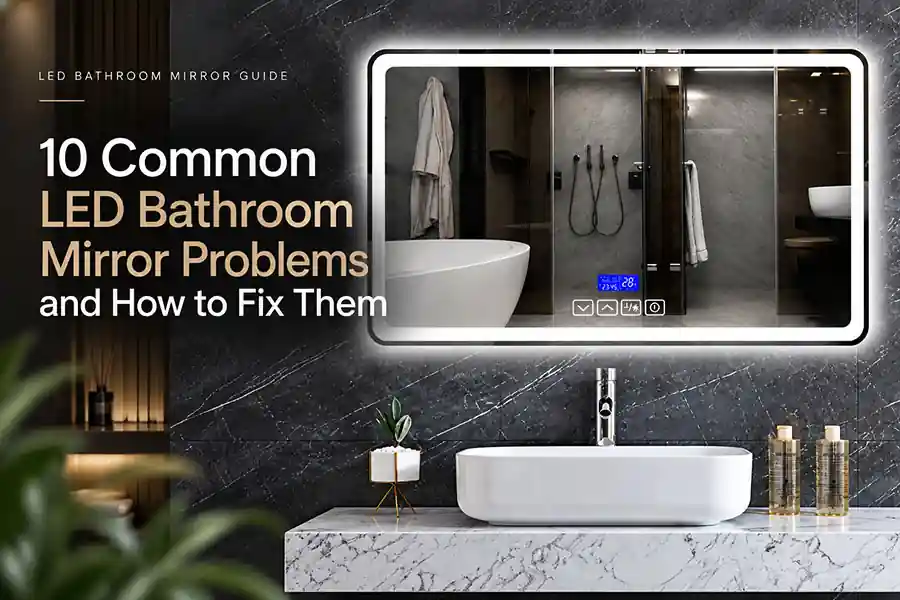
While LED bathroom mirrors offer modern aesthetics, resolving problems with LED bathroom mirrors efficiently is crucial for residential and commercial projects alike.
Common problems include lights that won’t turn on, flickering, uneven lighting, touch sensor issues, black edges and control conflicts. Other issues with LED bathroom mirrors include fogging, poor face lighting, unwanted sounds, black edges, and difficult repair access. Most standard & custom LED bathroom mirror models call for a check of the power, controls, lighting, defogger, or installation—not an immediate replacement. A bathroom mirror not working in a single home is inconvenient. but the same fault across a finished project creates repeat visits and delays.
This guide covers the 10 most common LED bathroom mirror problems. what each symptom usually points to, and what you should confirm before calling it a fault.
Safety first: Do not open a powered mirror or adjust internal wiring. If there is a burning smell, smoke, visible damage, or repeated breaker trips, stop using it. Have a qualified electrician or authorized technician assess it. Follow your specific mirror model instructions before attempting to clean the mirror, move, or repair it. (Refer HIB Electrical Bathroom Safety Information)
Quick Reference: 10 Common Issues with LED Bathroom Mirrors and Problems and How to Fix Them
| Problem and Symptom | Underlying Factory Cause | Problems and How to Fix |
|---|---|---|
| 1. Mirror won’t turn on (Dead unit or unlit strip) | Tripped breaker, disconnected terminal block, or an open circuit in the sub-assembly driver. | Verify wall switch sequences. Inspect input voltage. If the mirror fails to respond, isolate power and test the driver output. |
| 2. Flickering lights (Strobe effect or rapid cutting out) | Incompatible PWM dimming curves or low-voltage ripples from an aging driver. | Confirm dimmer module compatibility. Replace standard trailing-edge switches with verified LED-compatible dimmers. |
| 3. Dim or uneven lighting (Dark patches or drop in lumens) | Voltage drops across long serial runs or a localized failing led diode. | Check integrated brightness presets. Inspect for loose internal wire connections inside the mirror before deciding to replace the entire mirror. |
| 4. Erratic touch controls (Ghost touches or ignored inputs) | Shifted capacitive sensor pads behind the glass or structural surface contamination. | Isolate and clean the sensor area. Check for internal bracket shifting or sensor problems caused by rough transit handling. |
| 5. Memory or wall control conflicts (Settings reset after power cut) | Volatile memory chip designs or improper hardwire split tracking. | Verify if the IC chip supports non-volatile state memory. Reconfigure wiring to bypass secondary manual triggers. |
| 6. Persistent fogging (Steam fails to clear from glass) | Undersized demister element coverage or lack of dedicated relay power. | Allow a 5-minute warm-up window. To keep the mirror clear, make sure the mirror has its defogger activated independently rather than just turning on the led bathroom mirror light. |
| 7. Poor face lighting (Unflattering shadows or severe glare) | Incorrect choice of ambient backlit structures for a primary grooming station. | Adjust kelvin presets. For intricate grooming tasks, choose a front-lit led dressing mirror or an led framed mirror to optimize the bathroom feel. |
| 8. Acoustic buzzing or hums (Low-frequency vibrations) | Core saturation in lower-tier magnetic transformers or uncontrolled Bluetooth gains. | Check driver dampening pads. Mute automated Bluetooth pairing notification pings through your source settings. |
| 9. Black edges or silver oxidation (Dark, creeping spots on backing) | Chemical etching from trapped moisture or aggressive ammonia-based mirror cleaners. | The reflective layer is permanently damaged. Replace the glass sub-assembly and implement strict maintenance protocols instead of attempting to replace the mirror components yourself. |
| 10. Clearance and access issues (Mirror won’t seat on brackets) | Mismatched rough-in j-boxes or failure to account for vertical lift-off gaps. | Cross-reference site dimensions against technical drawings. Ensure the mirror is placed with a 20mm head clearance for bracket engagement to prevent mounting loose mirrors. |
Internal electrical checks, LED components replacement, and mounting corrections should follow the model’s instructions and be handled by qualified personnel.
For coordination with the cabinet, see our Bathroom Vanity Set Problems Guide.
If you want math bathroom vanity to buying mirrors, See Our LED Bahtroom Mirrors Buying Guide
Why Won’t LED Bathroom Mirror Turn On?
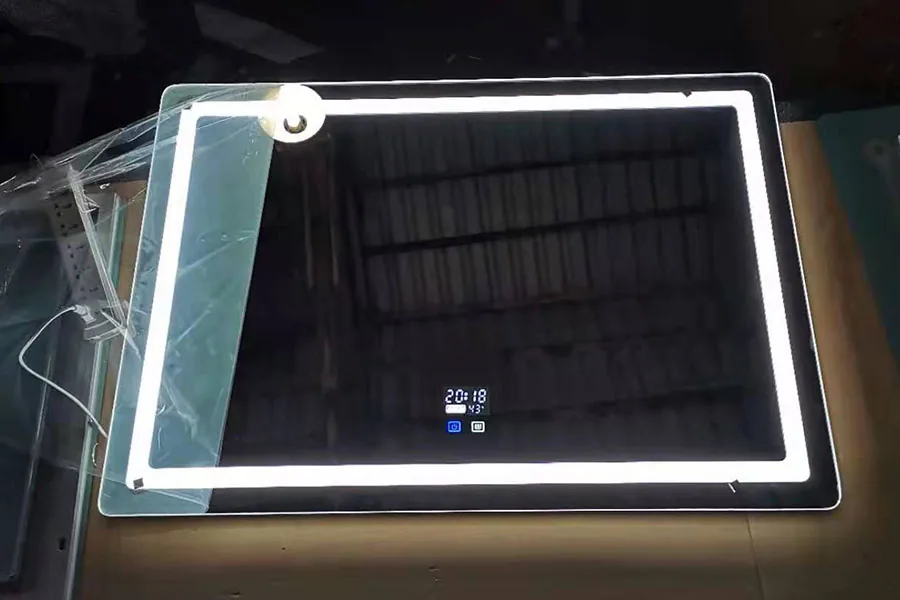
A mirror that will not turn on may have a power, connection, control, or lighting fault; the repair depends on which part has failed.
Start by noting whether the whole mirror is unresponsive or only the lighting has stopped working. That gives the supplier a better starting point than “the mirror is broken.”
Record these details without opening the unit:
- Does the touch-button indicator respond?
- Do other functions still work?
- Did the problem begin at installation or after normal use?
- Did it follow a power cut or a change to the wall controls?
Three situations need different handling:
- The whole mirror is completely dead. Check whether the circuit is live and the breaker has not tripped. A completely unpowered led mirror stops working entirely, and recent electrical work on the bathroom circuit is a common trigger. Confirm the mirror fully connects to its source.
- The button lights up, but the LEDs do not. The control board has power, but the lighting circuit or driver may not be receiving a signal.
- It never worked after installation, or failed after weeks of use. Note the installation date and whether the mirror ever worked correctly.
Follow the manual’s normal operating steps. Confirm whether the wall switch must be on before using the sensor mirror button. If the mirror remains off, send the model number, order details, and a short video to the supplier.
Kohler’s troubleshooting guide lists several possible mirror not working causes. including power, wiring, controls, and lighting led components. It does not treat every failure as a broken LED strip.
For a project order, agree on the acceptance test before installation. Test each approved function, not just whether the mirror lights up once.
Why LED Bathroom Mirror Lights Flickering?
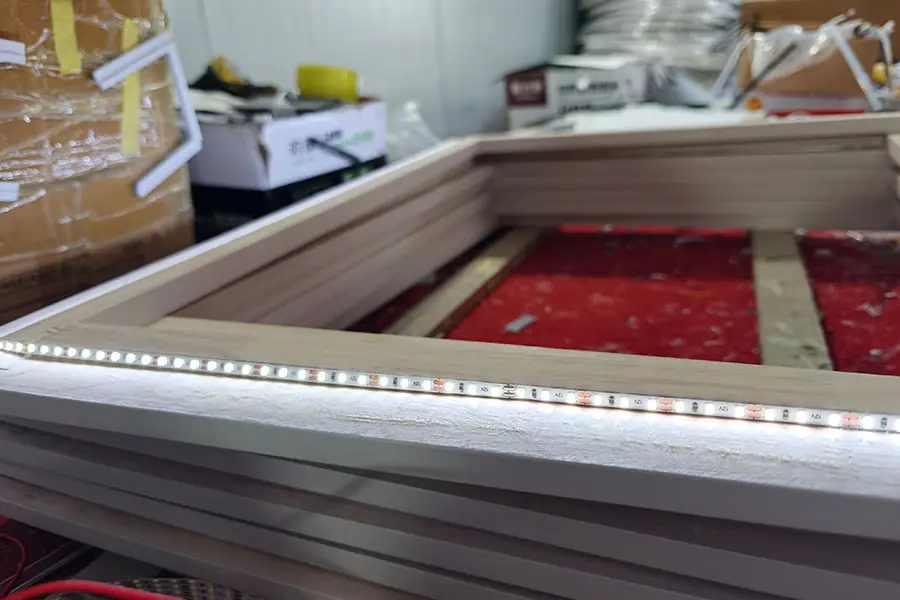
The most common cause of LED mirror flickering is an incompatible dimmer-and-LED driver combination, followed by unstable voltage or moisture ingress into connections.
Record when the flicker happens before assuming the LED driver has failed. A mirror that flickers only at start-up, only at low dimming levels, or only after 20 minutes of use is giving you diagnostic data. The pattern matters more than the flicker itself.
- Flickers only when first turned on. This often points to a start-up voltage issue or an ageing LED driver.
- Flickering led after dimming. This usually indicates a compatibility problem between the mirror’s driver and the dimming method, not a failed component.
- Flickers after the mirror has been running for a while. Moisture reaching a connection or a driver that is heating up can cause this pattern.
Lutron’s LED load guidance explains that unsuitable dimmer-and-load combinations can cause flicker and erratic operation. That makes compatibility worth checking, but it does not prove the dimmer caused every case.
Ask the installer or supplier to assess the reported conditions. If the controls are incompatible, have the installer use an approved combination. Do not bypass the controller as a trial fix.
Before a bulk order, test the sample with the intended controls. A successful test using a different switch leaves a question unanswered.
Why Are LED Mirror Lights Dim, Uneven, or Only Partly Working?
Problems with the led output, such as uneven led strips or dim performance. Dim or patchy light may need a setting correction, a connection repair, or replacement of a faulty lighting component. First separate a recent change from a mirror that never provided enough light. A section of the LED strip that is out usually points to the strip itself or a connection to it, not the whole unit.
When bathroom mirror lights fail partially, check if the issue is a loose connection inside the mirror before deciding to replace the entire mirror.
| What you notice | What to check or report |
|---|---|
| The whole mirror surface has become dimmer | Confirm the normal brightness setting, then report when performance changed. |
| One side or section stays dark | Record its location and whether the other functions work. |
| Bright spots and dark areas were present from delivery | Compare photos taken under consistent conditions with the approved sample. |
Manufacturer troubleshooting treats one unlit side separately from complete failure because the required repair can differ.
Before accepting a replacement, confirm the part number and expected light color. A repair should restore the agreed appearance as well as basic operation.
Ask whether the affected part is replaceable. Confirm the correct part number before ordering it.
Touch Control Buttons or Motion Sensors Not Working Properly?
Control problems may involve surface obstruction, sensor problems, internal contact, or a failed component. The right fix depends on whether the control ignores input, misses movement, or activates unexpectedly.
When a touch sensor mirror not working arises, it is important to separate sensor problems from mechanical failures. A sensor mirror requires careful handling; a non-responsive touch button and a motion sensor that fails randomly are caused by different common reasons.
To fix the issue, first clean the sensor area. Mineral deposits, soap residue, and water stains in the bathroom environment can block the capacitive sensor area, making it seem like you have permanent sensor issues.
Unresponsive Touch Controls: Sensor Alignment and Contact Problems
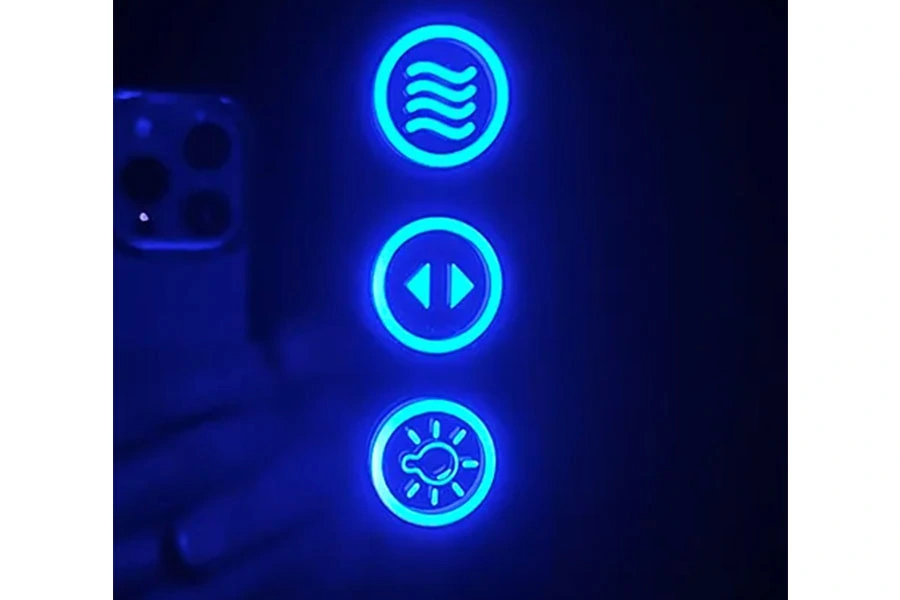
Yes—on some capacitive-touch designs, a displaced sensor issues or poor contact behind the mirror can affect response. Infineon’s design guidance explains that an air gap between the sensor and its cover reduces sensitivity.
Clean the touch zone first, then check the sensor’s physical position. Mineral deposits, soap residue, and water stains can affect responsiveness even when they are not visible. For mirrors that use an attached capacitive sensor structure, the fixing, position, and contact state of the sensor pad behind the glass are worth checking.
If touch response is poor after delivery, ask the service team to check the approved sensor position and attachment. Movement or separation is a possibility to investigate, not proof that transport caused the fault.
Why Does the Sensor False Activation or Turn the Light On Unexpectedly?
The sensor may be operating outside its intended conditions, using an unsuitable setting, or failing to detect correctly.
Write down the control type, the surrounding environment, and the exact conditions. A mirror that turns on by itself, a sensor that misses a hand wave, and a light that will not shut off each need different information.
Record these five points: control type, what was nearby, what the user was doing, what the mirror did, and what setting was active. Radar sensing range and shut-off delay vary by model. Do not assume a feature is present until the specification confirms it. For project buyers, confirm detection range, shut-off logic, and manual override during sample approval.
For the sample, agree on three behaviors: what turns the light on, how long it stays on, and how it turns off. Do not assume one sensing distance or delay applies to every model.
Wall-Switch, Dimmer, and Memory-Function Problems
These problems can result from control incompatibility or from choosing a model whose operating behavior does not match the room. A setting change may help, but it cannot supply a feature the product does not support
Treat the mirror’s own dimming, wall-switch dimming, and memory function as three separate specifications. A mirror that has touch dimming on the glass face does not automatically support an external wall dimmer. A mirror that remembers brightness does not necessarily remember the defogger setting.
Is the Mirror Compatible with the Wall Switch or Dimmer?
Only the model’s specification can confirm whether it supports ordinary switching, external dimming, or both.
Check the driver rating, not just the switch type. A common situation: the wall switch turns on, but the user still has to press the mirror button to get light. That is not necessarily a fault. It may be the intended control sequence.
Confirm the expected operation before installation. If the project requires the wall switch to control everything, the mirror must be specified that way. Ask the contractor to provide the exact controller model or control method and confirm it against the mirror’s driver specification before approving the sample. Lutron’s guidance shows why compatibility depends on the equipment combination, not just its wattage.
Will the Mirror Remember Its Settings After a Power Supply Cut?
It will only retain the settings supported by its memory design; switching off at the mirror may behave differently from cutting power.
Test three things: whether the light comes back on, whether brightness is retained, and whether colour temperature is retained. Power-on behaviour is not the same across models. Some mirrors return to their last state; others reset to a default.
In hotel projects, the key-card power supply is cut when the guest leaves. Whether the mirror returns to a guest-friendly state after re-entry depends on the memory design. Test this with your actual sample and power system, and write the expected behaviour into the specification sheet.
Why Anti-Fog Bathroom Mirror Still Fogging Up?
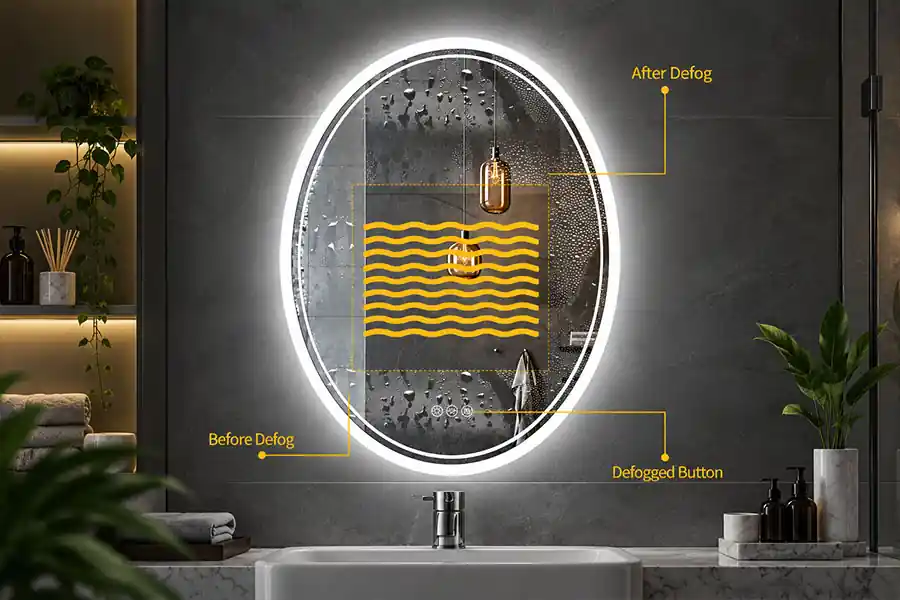
Why anti-fog bathroom mirror not working as expected? The defogger may not be activated. Its heated area may be smaller than expected, or its heating system may need repair. These situations require different responses.
Check the heating area and the activation method before calling it broken. Turning on the led bathroom mirror light does not always turn on the heating pad automatically. Managing bathroom mirror fogging effectively prevents moisture from degrading the inner backing over time. An anti-fog mirror that stays cloudy after a shower is not always faulty. The defogger pad may need more warm-up time, may only heat the centre of the glass.
Its HiB’s Vega drawing shows the heating area separately. These details are specific to those products.
Three questions to answer:
- Was the heating function started as instructed? On many models, the light and the defogger are separate functions. Turning on the lighting does not always activate the heating pad. Look for a touch button marked with rising steam lines or the word “defog”.
- Does the clear area match the heating area? The demister pad covers a specific zone. Edges that stay foggy are often normal. Check the stated anti-fog coverage area.
- Has the performance changed over time? A mirror that used to clear and now does not may have a failed pad or a connection issue.
Heavy steam, a dirty mirror fogging surface, or a room with no exhaust can also reduce performance. The heater reduces condensation on the glass. It does not remove humidity from the room. Do not remove a hardwired mirror to inspect the pad yourself.
Why Mirror Poor Lighting for Makeup or Shaving?
A standard LED mirror can work correctly yet provide unsuitable light for grooming because brightness, direction, and placement do not match the task. The answer may be better lighting, not electrical repair.
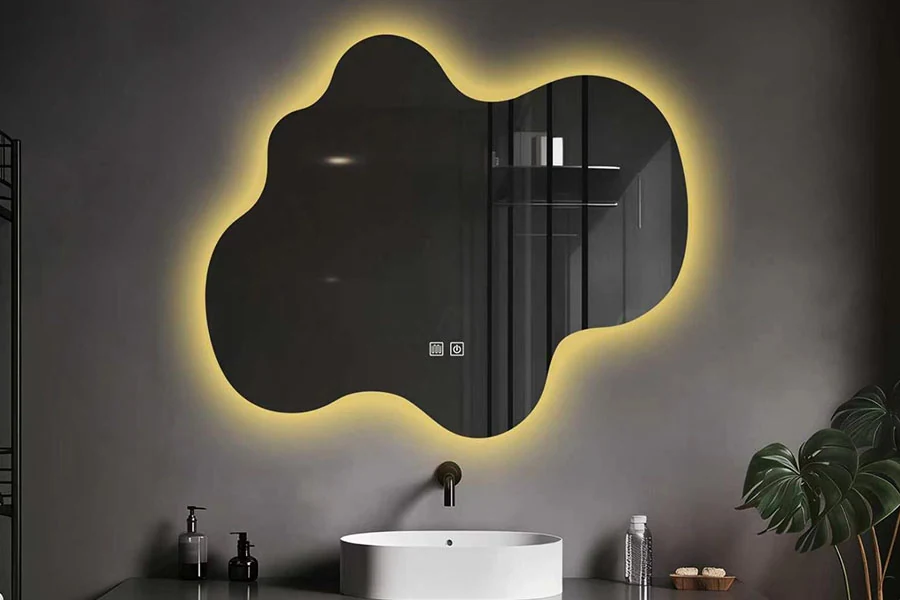
Backlit mirrors create a glow around the mirror edge. That looks good in photos, but it can leave the face darker than the background. Front-lit mirrors, positioned to reach the face directly, solves this. The difference is not about lumens alone.
Why Does a Bright Mirror Still Leave My Face in Shadow?
The light may illuminate the wall or room more effectively than your face. Assess its position and direction, not only its apparent brightness.
Look at your face in the mirror, not at the wall brightness. A mirror with high total lumen output can still produce shadows under the eyes, nose, and chin if the light comes only from behind the glass. Therefore, if you need to apply makeup meticulously, you’ll need a frontlit LED bathroom mirror. Just backlit mirror is not sitable.
For project buyers, specify the lighting for the actual use. A hotel bathroom used for shaving needs different light placement than a powder room used for quick checks. Test the sample in a room with similar dimensions and finishes.
Robern describes its forward-facing task lighting as designed to reduce facial shadows.
How Can I Check Glare, Light Color, and Comfort?
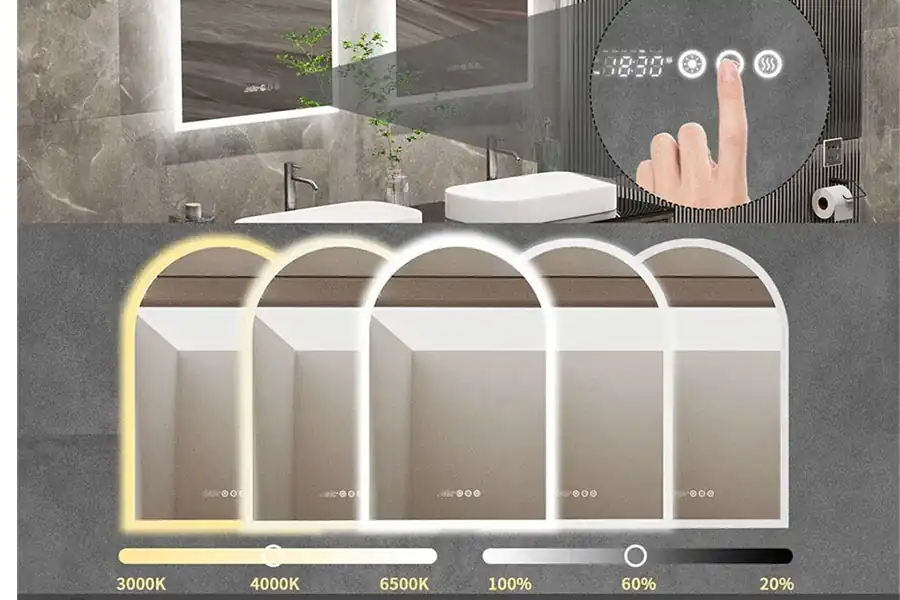
Adjustable settings can improve comfort when the model supports them; otherwise, the lighting specification may need to change.
Compare comfort, colour, and facial illumination as a set. Glare from a poorly positioned light source is uncomfortable regardless of colour temperature.
For hotel projects, guest feedback often mentions how the lighting feels, not what the colour temperature number is. In feedback shared with us, one hotel guest said the mirror made them feel younger. That was a personal reaction, but it shows why the experience deserves attention.
A showroom look is not a daily-use test. Choose a setting that feels pleasant and helps you see what you are doing. For multiple rooms, keep the approved sample and lighting settings as the reference.
A typical smart LED mirror offers three adjustable color temperatures (3000k-6000k) or a single color. It has a CRI > 90 and good color rendering.
Why LED Mirror Make Unwanted Sounds?
It could be an electrical buzzing, or it could be a noise caused by poor speaker quality after Bluetooth connection.
Electrical buzzing and loud Bluetooth prompts have different causes and fixes. Electrical noise needs assessment; a connection announcement may require a supported sound setting or a different product configuration.
Separate continuous electrical noise from Bluetooth prompts. A buzzing sound that comes from the mirror body is different from a voice prompt that announces a Bluetooth connection. They have different causes and different fixes.
What Should Do About Buzzing or Humming?
Have the supply and control combination assessed rather than assuming the LED strip is faulty. Note whether the sound changes with dimming or another function.
Note whether the sound changes with dimming or appears only when the light is on. A buzz that appears or changes when you adjust brightness often points to a dimming compatibility issue. A constant hum may involve the driver or the power supply. Do not try to identify the part yourself. Record a short video, note the model and the operating state, and send it to your supplier.
Can Loud Bluetooth Connection Prompts Be Changed?
They can only be changed if the model supports a prompt-volume or mute setting. Ask the supplier rather than assuming music volume controls every sound.
Confirm the volume of every audio prompt before a bulk order. Some Bluetooth mirrors produce a pairing tone, a connection announcement, and a disconnection sound. If the volume is fixed and loud, it can be disruptive in a hotel room at night.
A user comment shared with us warned about loud sounds during Bluetooth connection. This supports checking the connection experience; it does not prove that all lower-priced mirrors have faulty speakers.
Why Are Black Edges or Dark Spots Appearing?
Persistent marks may involve the mirror’s reflective coating rather than removable surface dirt. Distinguish surface contamination from a problem with the mirror’s reflective layer. Black edges that wipe away are surface residue. Black edges that remain after cleaning may involve the silver backing or the edge seal.
AGC’s mirror-cleaning guide warns that cleaning liquids left on edges can contribute to black edges. It recommends drying the edges thoroughly after cleaning.
Follow the selected mirror’s care instructions. Avoid trying stronger chemicals to remove a mark behind the glass. Ask whether the damage affects the reflective layer and whether replacement is needed.
For a claim, provide photos, the cleaning products used, installation details, and the model number. Keep the cause open until checked.
When ordering again, request care instructions and written terms covering glass and edge defects—not just electronics.
Installation Problems with LED Bathroom Mirrors
Incorrect mounting, cable positions, or removal clearances can turn a small repair into a larger site problem. The remedy is to correct the installation safely and plan access before repeating the design.
Confirm both “can it be installed” and “can it be serviced later” before the wall is closed. Many installation problems appear months later, when a component fails and there is no clear way to reach it.
What Should the Installer Check Before Hanging the Mirror?
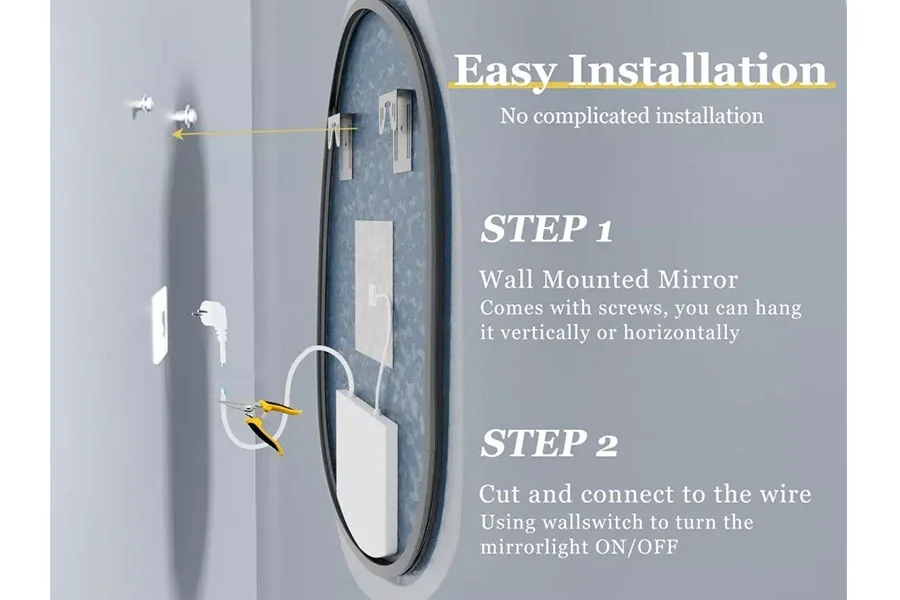
Check the back drawing for mounting points, cable exit, and clearance. LED mirrors vary in where the cable exits, how the bracket attaches, and how much space is needed around the back panel. A mirror that fits the wall may still leave no room for a plug or a connection.
Confirm the mirror’s mounting diagram against the actual wall conditions before installation. Do not assume standard dimensions across models. For vanity combinations, check the alignment between the mirror and the cabinet at the same time.
Can Components Be Reached Without Damaging the Wall Finish?
That depends on the mounting system, available clearance, and serviceable parts. Check the removal method before fitting a mirror tightly against a ceiling or cabinet.
For an installed unit, ask for the model’s removal instructions. Do not improvise by prying against the glass or tiles.
For a new order, confirm:
- Required removal space
- Accessible components
- Approved replacement parts
- Who performs the repair
The U.S. Department of Energy treats serviceability separately from LED life. A long component-life claim does not tell you whether the finished product is easy to repair.
What Problems Should Hotels, Contractors, and Mirror Brands Resolve Before Buying?
The same mirror problem looks different depending on who you are. Especially for customized and wholesale projects. Different projects present different challenges for different buyers. These include issues such as custom logos, time displays, packaging, shape, and frames. These are common problems faced by buyers seeking custom bathroom mirror suppliers for large projects.
Hotels Owns or Hospitality Project
Confirm that the controls are intuitive for guests. The lighting actually illuminates the face. The audio prompts do not disturb the room. and every room in the batch behaves the same way. The conclusion is not a specification sheet. It is a working sample in a test room. Enhance the guest stay experience.
Builders and contractors
It’s not just a problem with the mirror itself, but also a problem with the entire project. For engineering orders, is a five-in-one packaging necessary to save space and transportation costs? Are there any deadlines?
Confirm cable positions, mounting details, controls, and removal space before finishes are complete. Agree who checks the site and who handles product questions. Ask for drawings before fixing the electrical layout.
Mirror Brands (Sanitary Ware Brand or Kitchen and Bathroom Brand)
The back of the mirror product also deserves review. A glass producer developing an LED mirror brand approached Dlinxcy with concerns about ordinary foam strips. Their rough surface and dirty-looking color did not meet the desired finish. We proposed a finer white sponge strip alongside a selected waterproof COB LED strip and protective box. Dlinxcy appears here as the partner that made the adjustment. The client accepted the revised solution against its appearance and water-protection requirements.
That approval is not an IP test report. UL evaluates enclosures and related components against defined requirements. A component rating alone is not proof of the finished mirror’s rating.
FAQs: What Should You Know About LED Bathroom Mirror Problems?
Repair options depend on the model, so confirm the details rather than relying on a general lifespan or feature claim.
Q1: What Are the Downsides of LED Bathroom Mirrors?
A: The main trade-off is added maintenance planning compared with plain glass. LED mirrors add electronic components, power supply considerations, and repair planning. The glass and frame last a long time; the electronics may not. Buyers should weigh repairability and spare parts availability, not just features.
Q2: How Long Do LED Bathroom Mirrors Typically Last?
A: There is no single reliable lifespan for every complete LED mirror. Under normal circumstances, the LED strip is typically rated for 50,000 hours. If you use it for 5 hours a day, it can last approximately 27 years. Inferior LED bulbs may experience severe light decay, flickering, or failure to light up within 1-2 years.
A quoted LED operating life is not a promise for the driver, controls, heater, or whole assembly. The U.S. Department of Energy makes this distinction for LED systems.
Q3: Why Isn’t My LED Bathroom Mirror Working?
A: The supply, the control, or the lighting section needs to be identified first. A completely dead mirror is usually a supply or sensor issue, not a failed LED strip. Record your model and symptoms and contact your supplier.
Q4: Why Is the Touch Button Lit but the Mirror Light Off?
A lit indicator does not prove that the lighting circuit is working correctly. Follow the model’s normal control instructions and note whether the indicator changes when touched. If the lighting still fails, send that information to the supplier. A technician may need to assess the control, light supply, connections, or lighting assembly. Do not open a powered mirror.
Q5: Can the LED Lights in a Bathroom Vanity Mirror Be Replaced?
A: It depends on the mirror’s construction and whether matched parts are available. Some models use replace the mirror strips; others are sealed modules. Ask the manufacturer for the model-specific repair method before buying a generic strip. A qualified person should handle any replacement. Do not attempt a generic strip installation.
Q6: Should an Anti-Fog Bathroom Mirror Clear the Entire Surface?
A: Check the heated area for your model. I don’t think it’s necessary for the storage mat to cover the entire mirror surface. Normally, it’s made to cover 60% of the mirror area unless the customer has specific requirements. Customizing the defogging area would increase the cost.
Conclusion: How Can You Prevent the Same Problems from Returning?
Start with the symptom, then confirm the model, the control method, and the site conditions. The answer may be a setting change, a professional repair, a replacement part, or a new mirror. If you already have a fault, prepare the model number, photos, and a video and contact your original supplier.
If you are planning a new bathroom mirror project, send your photos or drawings, control requirements, and mirror functions. Dlinxcy can rpovide LED mirrors, mirror cabinets, and coordinated bathroom vanity sets solutions for your projects
Related Article:
- Top 15 Bathroom Vanity Cabinet Manufacturers Worldwide
- Best Material for Bathroom Vanity Cabinet: Buying Guide
- Single Sink vs Double Sink Bathroom Vanities Guide
- Custom Bathroom Vanity With Sink: How to Choose
- Custom Bathroom Vanity With Sink: How to Choose
- Freestanding vs. Wall-Hung Bathroom Vanities
Send Inquiry To Dlinxcy Experts