Contact Dlinxcy, Get Your Solutions!
Dlinxcy Supplies OEM & ODM Bathroom Vanity Sets, Bathroom Cabinet, LED Mirror, Mirror Cabinets Services for You. Contact us now for a Quote or Samples.
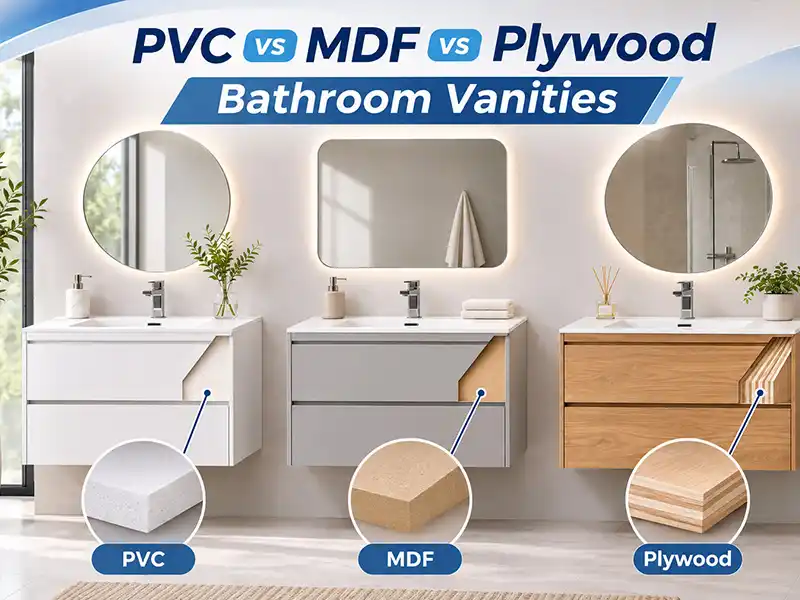
For commercial bathroom vanity projects, PVC foam board is a suitable option for humid, poorly ventilated bathrooms due to its low water absorption. Plywood is often preferred where structural rigidity and secure hardware fixing are important, while moisture-resistant MDF (MDF.H) provides a smooth surface for painted doors and panels when properly sealed.
When comparing PVC vs MDF vs plywood bathroom vanities, the best choice depends on more than the core material. Buyers should evaluate edge protection, hardware reinforcement, cabinet construction, and the material compliance documents required in their target market.
For countertop, basin, and sintered stone options, see our Best Material for Bathroom Vanity Cabinet buying guide.
Key takeaways:
When evaluating wholesale bathroom cabinets for a multi-family housing project or hospitality vanity supply, comparing two options as whole units is critical. One generic material name can mask vast quality gaps.
In a professional bathroom vanity carcass blueprint, the cabinet box core, surface finish, edge banding technology, and high-load hardware work as a system to handle humid bathroom microclimates.
The core is the board that forms the cabinet box, and the finish is only the surface layer on top. Two white painted vanities can look the same on a showroom floor and still sit on different cores.
For Example: Two white painted 600 mm (24 in) vanities appear on one quote sheet. One vanity has a plywood core and the other has standard MDF, and the paint hides that difference until water reaches a cut edge.
Edge banding is a strip that covers the cut edge of a panel. Hardware means the hinges, drawer runners and wall fixings that carry the loads of doors, drawers and tops. Woodworking Network’s Wood Doctor column notes that water entering MDF through the finish or a fastener hole causes serious swelling. Ask the factory to state the board type and thickness for the carcass, back panel, doors and drawers.

Plywood is made from layers of wood veneer, MDF from wood fibers and resin, and PVC foam board from foamed plastic.
Plywood is a panel made from layers of wood veneer laid in cross layers and joined by an adhesive. For the US market, the EPA rule describes hardwood plywood as layers, or plies, of veneer joined by an adhesive. Plywood can be painted or stained, or faced with a wood veneer that shows natural wood grain.
Medium-density fiberboard (MDF) is a panel made from wood fibers coated with resin and pressed into a dense and uniform sheet. For the US market, the EPA rule defines MDF as cellulosic fibers formed and pressed from a resinated fiber mat. MEDITE SMARTPLY describes its MEDITE MR board as giving a uniform, smooth finish for painting, laminating or veneering.
PVC foam board is a rigid sheet of foamed polyvinyl chloride that some factories use as a cabinet core. Free-foam PVC expands outside the die to form a matte cell structure, while celuka PVC cools inside a calibrator to form a dense outer skin. Ask the supplier to state the foam process and density of the PVC board in each model.
A “PVC vanity” can mean a cabinet built from PVC foam board, or a cabinet with PVC film vacuum-pressed over an MDF or particleboard core. In the US, the Composite Panel Association defines these film-wrapped parts as thermofoil or RTF, short for rigid thermofoil. The film covers only the surface, so the board underneath decides what happens at a cut edge.
Common mistake: Reading “PVC” on a quote as proof of a PVC core. Write on your RFQ (request for quotation) whether PVC is the core or the surface film, and ask for a cut sample of the edge.
A material comparison holds only when every quote shares one baseline, so run this one-baseline check before you compare cores:
When a quote changes one of these five points, part of the gap in price or performance comes from that change.
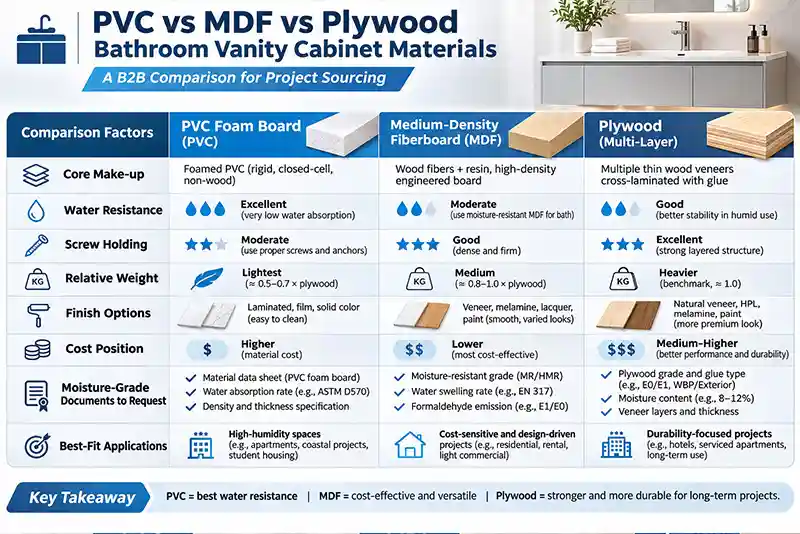
PVC, MDF and plywood vanities differ most in how each core takes up water, holds fixings and accepts a finish. Dlinxcy builds plywood and PVC cabinets; the MDF column uses public sources.
Table 1. PVC foam board, MDF and plywood cabinet cores compared on seven points, assuming one size, finish, edge and hardware baseline.
| Factor | Plywood | MDF | PVC foam board |
|---|---|---|---|
| Core make-up | Layers of wood veneer joined by an adhesive | Wood fibers coated with resin and pressed into a sheet | Foamed PVC sheet; the foam process depends on the board maker |
| Where water gets in | The panel takes up moisture from the air, so risk sits at unsealed edges, cut-outs and screw holes | Water entering through the finish or fastener holes causes thickness swelling | The board takes up very little water [F01], so risk sits at joints, holes, fixings and non-PVC parts |
| Screw holding | Tends to be stronger and stiffer than MDF of the same thickness | Conventional fasteners in the face and edges are not strong | Depends on board density and inserts; ask for the board maker’s fastening guidance |
| Relative weight | Lighter than MDF | Heavier than plywood | Palram lists Palight sheet at 0.65–0.7 g/cm³ for 3 mm and 0.55–0.6 g/cm³ for 10 mm |
| Finish options | Depends on the face veneer and coating system | Smooth surface for painting, laminating or veneering | Depends on the paint system the board maker approves |
| Cost position | Plywood veneer raw material costs more than MDF raw material | MDF raw material cost is not high compared with plywood veneers | Depends on density, thickness and quote scope |
| Moisture-grade document to request | EN 636-2 or EN 636-3 declaration (European plywood use classes) | MDF.H declaration under EN 622-5 (European MDF specification), plus an EN 317 swelling report | Density, foam process and fire data from the board maker |
Board grade, edge banding and hardware can change the result within one material, so compare grade documents as well as board names.
In MDF vs plywood cabinets for a bathroom, plywood is usually the better carcass core when the cabinet carries hinges, runners and wall fixings. Woodworking Network’s Wood Doctor column states that MDF tends to be less strong and less stiff than plywood of the same thickness.
Plywood and MDF both react to moisture in a bathroom, but each board reacts in its own way. APA notes that plywood is hygroscopic and responds to changes in environmental moisture. Woodworking Network notes that MDF swells in thickness when first exposed to liquid water or high humidity.
MDF keeps a clear advantage on painted surfaces. MDF is also heavier than plywood, which adds load on a wall-hung cabinet.
For plywood carcass options, see Dlinxcy plywood bathroom vanities.
Dlinxcy’s 1500mm Double Sink Plywood Bathroom Vanity (model AS813047) provides a practical example of how plywood is used in a wall-hung bathroom cabinet.
The 1500mm version features a cabinet measuring 1500 × 500 × 452 mm, paired with an integrated double-basin sintered-stone countertop and a 1500 × 700 × 35 mm LED mirror. The product specification lists plywood and solid wood as construction materials, a Warm Mist Brown lacquered and melamine finish, one or two-drawer configurations, and Unihopper soft-closing drawer slides.

For a humid, poorly ventilated bathroom, PVC foam board is the safer core, because the board itself takes up very little water. Plywood suits projects that want a wood-veneer look, provided the board carries a humid-class declaration.
PVC’s main trade-off against plywood is hardware fixing, because screw holding in PVC foam board depends on density and inserts. No published screw-holding data for PVC foam board was found for this article. Ask for the board maker’s fastening guidance before you specify PVC for wide drawers or a wall-hung cabinet.
PVC’s main trade-off against plywood is hardware fixing, because screw holding in PVC foam board depends directly on board density and uniformity. Furniture-grade PVC sheets (0.55–0.65 g/cm³) strip easily when screws are tightened. For bathroom vanity carcasses, Dlinxcy specifies cabinet-grade PVC board at about 0.60 g/cm³ with an even density all the way through, which gives hinges and drawer runners a firm, consistent bite across the full thickness of the panel. For wide drawers or heavy wall-hung cabinets, always verify the board’s exact density and ask whether the factory uses expansion dowels or pre-inserted nylon anchors at high-load points.
For PVC carcass options, see Our PVC bathroom vanities and the wall-hung PVC vanity with two drawers.
In a PVC vs MDF bathroom cabinets choice, PVC bathroom cabinets handles water exposure better, while MDF gives the smoother painted surface. Woodworking Network notes that MDF swells in thickness when liquid water or high humidity reaches the board.
MDF fits door fronts in a dry, ventilated zone, where its flat surface shows paint well. PVC foam board fits the carcass in wet zones, where the base and back panel face splashes and leaks.
Neither board has a clear screw-holding advantage without test data for the actual boards. Conventional fasteners in MDF faces and edges are not strong, according to Woodworking Network. For either board, ask the supplier how hinges and runners are fixed.
None of the three cores makes a complete vanity waterproof by itself. The core decides how fast water does damage, and where that damage starts.
Yes. A PVC foam board is waterproof. PVC foam board generally has low water absorption, but this alone does not establish that a finished vanity is waterproof. Check the exact board specification, joints, backing panels and fixing details.
Palram’s Palight physical properties sheet lists water absorption tested for 24 hours at 23°C under ASTM D570. The listed results are 0.5% for 3 mm (0.12 in) sheet and 0.8% for 10 mm (0.39 in) sheet.
Kömmerling’s KÖMATEX technical values list water absorption below 0.3% after 7 days, tested to DIN 53495. Both figures describe sign and display sheet from these makers, not every cabinet board. Ask for the data sheet of the exact board used in your model, with its test method.
A PVC cabinet can still let water in at panel joints, drilled holes, hinge and runner fixings, non-PVC parts and the wall fixing. Non-PVC parts include back panels or drawer bottoms made from another board. A low-absorption board does not prove that the assembled cabinet is waterproof.
Engineering note: Paint or lacquer on PVC foam board is chosen mainly for color and gloss, because the board already takes up little water. Paint adhesion depends on the paint system and surface preparation the board maker specifies.
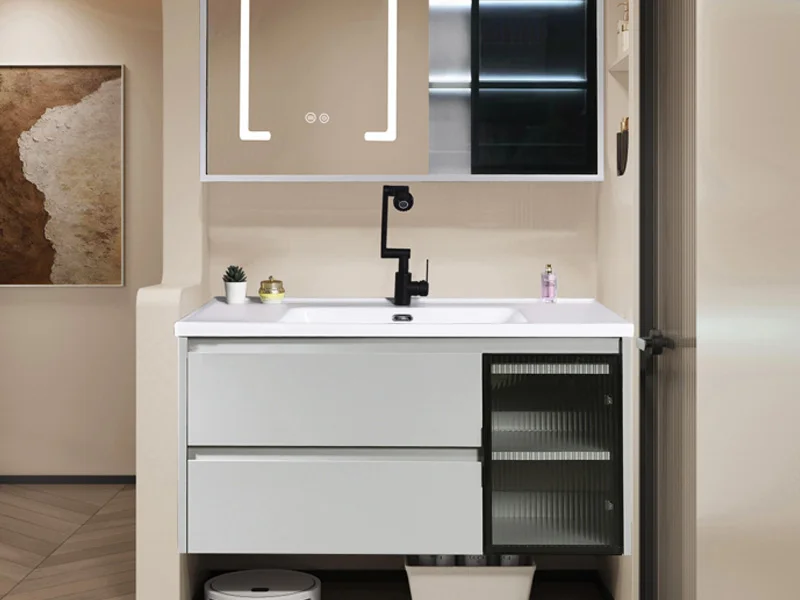
Plywood is not 100% waterproof, and APA notes that plywood is hygroscopic and responds to changes in environmental moisture. Plywood cabinets need proper edge banding to improve their water resistance. APA’s moisture-related dimensional stability guide covers expansion and swelling in plywood panels.
BS EN 636 is the European plywood specification that classifies plywood by use condition. The classes are EN 636-1 for dry conditions, EN 636-2 for humid conditions and EN 636-3 for exterior conditions. For a bathroom vanity, ask for an EN 636-2 or EN 636-3 declaration on the actual board.
Plywood trade names can mislead buyers, so check the standard behind each name. BSI states that BS 1088:2018 covers marine plywood intended mainly for marine craft and waterway uses. BSI also states that BS 1088 does not make provision for other properties a particular end use may need. An NBS article on plywood for exterior use notes that “WBP” is no longer a term in current British or European standards.
MDF can go in a bathroom vanity when the board is a humid-use grade and stays clear of standing water, but MDF is not waterproof. An MDF bathroom vanity works best with doors and panels in a ventilated room with a separate wet zone.
Standard MDF and moisture-resistant MDF are different products, and the difference shows in the standard grade. EN 622-5 is the European specification for dry-process fiberboard (MDF), and it includes a type for interior humid conditions. MEDITE SMARTPLY states that its MEDITE MR board meets that type, listed as MDF.
MEDITE SMARTPLY describes MEDITE MR as a moisture-resistant MDF for interior humid conditions such as kitchens and bathrooms. The maker answers “No” to whether MEDITE MR is waterproof, and states that wetting of the panel should be avoided.
MDF fails first at cut edges, the basin cut-out, the cabinet base and any slow leak. MDF swells in thickness when first exposed to liquid water or high humidity. BS EN 317 is a test method that measures how much particleboard or fiberboard swells after immersion in water.
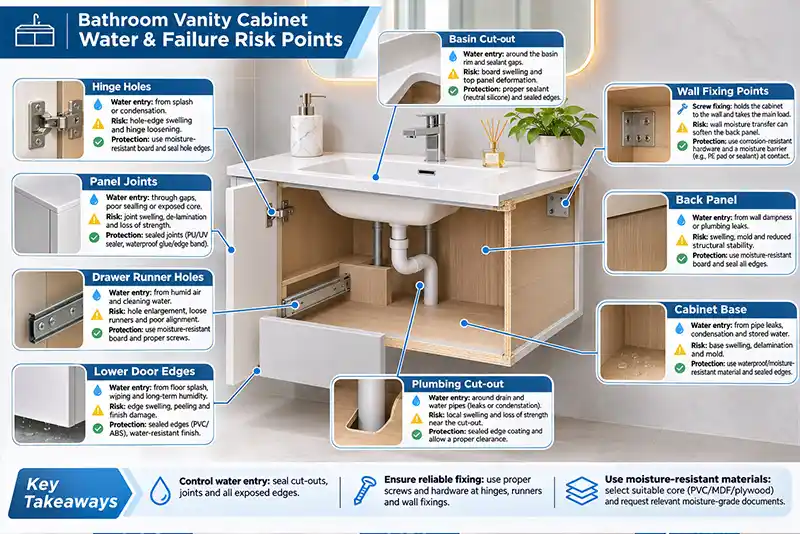
Water usually reaches a vanity core through cut edges, holes and joints, so check those parts first.
Table 2. Where water reaches a plywood, MDF or PVC foam board cabinet, and what to check at each part.
| Cabinet part | Plywood | MDF | PVC foam board | What to check |
|---|---|---|---|---|
| Toe kick and cabinet base | Exposed edge takes up moisture | Edge swells if water reaches the core | Board takes up little water; joints stay exposed | Sealed bottom edge, raised base or wall-hung fixing |
| Basin and waste cut-outs | Cut edge exposed after drilling | Cut edge swells if water reaches it | Board edge takes up little water; pipe gaps stay open | Sealant or edge banding on every cut-out |
| Back panel | Depends on the back panel board | Depends on the back panel board | Depends on whether the back panel is PVC | Board type and thickness of the back panel |
| Hinge and runner holes | Screw holes open the core | Fasteners in face and edges are not strong | Depends on density and inserts | Inserts and hole sealing |
| Panel joints and edge banding | Gaps let water reach the core | Gaps let water reach the core | Gaps let water behind the cabinet | Edge banding type and joint sealing |
| Lower edge of doors | Worn edge banding exposes the core | Worn edge banding exposes the core | Depends on the film or paint finish | Edge banding on all four door edges |
| Wall fixings | Depends on bracket and carcass build | Depends on reinforcement | Depends on density and inserts | Bracket type, fixing method and wall build |
Common mistake: Checking the door material and skipping the cabinet base and back panel. The base and back panel sit closest to leaks, so ask for their board type in writing.
Several common claims about vanity cores go further than the evidence, so match each claim with a document.
Table 3. Common vanity material claims, what public sources show, and the document to request instead.
| Common claim | What public sources show | What to ask the factory for |
|---|---|---|
| PVC cabinets cannot take up any water | Board makers’ data sheets list low but measurable water absorption | Water absorption data for your board, plus the cabinet build |
| A fixed share of cabinet failures comes from edge sealing | No published source for a fixed share was found for this article | A cut sample that shows the edge banding |
| Each board has a fixed lifespan in years | No common test supporting a year figure was found for this article | Warranty terms and any test reports |
| Marine or WBP plywood removes water risk | BS 1088 targets marine craft; WBP is not a current standard term | The declared standard and bond class |
| A TSCA Title VI label (for the US market) shows moisture resistance | The label relates to formaldehyde emission rules for composite wood | A separate moisture-grade declaration |
Choose the core by the bathroom’s water exposure and hardware load, then confirm the choice with board documents. The scenarios in Table 4 are editorial examples for planning, not records of Dlinxcy projects.
Table 4. Five common project conditions, the cabinet core to start with, and what to confirm before you decide.
| Project condition | Usually start with | Check before you decide |
|---|---|---|
| Hotel guest bathroom with good ventilation and a wood-grain finish | Plywood bathroom cabinets | EN 636-2 or EN 636-3 declaration and sealed cut-outs |
| Rental or student apartment with poor ventilation and frequent cleaning | PVC foam cabinets | Fastening guidance and inserts for hinges and runners |
| Retail range with painted flat or shaker doors and a cost target | MDF.H doors, with the carcass assessed separately | MDF.H declaration and an EN 317 swelling report |
| Humid climate market or a steam-heavy shower room | PVC foam board, or humid-class plywood with sealed edges | Water absorption data or EN 636 class, plus edge banding |
| Wide drawers and heavy daily use | Plywood carcass | Runner type and how runners are fixed to the side panel |
If a supplier does not offer MDF doors, compare a painted plywood or PVC door for the retail range. For guest room specifications and project supply, see Our hotel and hospitality vanity solutions.
Some builds have no single right core, because the load path matters more than the board name. Example (hypothetical): A 1200 mm (47 in) wall-hung vanity carries a heavy sintered stone top. The result depends on the wall build, the brackets and the carcass reinforcement.
A mixed build is another case without one answer, because a PVC or plywood carcass can take MDF.H doors. Each board in a mixed build needs its own grade declaration. Ask the supplier to list the board for every part on the quote.
Solid wood suits buyers who want natural wood grain, but solid wood still takes up moisture from the air. The USDA Forest Products Laboratory’s Wood Handbook, Chapter 4 states that wood is hygroscopic and takes on moisture from the surrounding environment. For a solid wood vanity, ask how the edges, cut-outs and base are sealed, as you would for plywood.
The formaldehyde documents you need depend on the destination market, so state the market on the RFQ before the factory quotes. Formaldehyde rules protect indoor air quality, and each market sets its own limits and paperwork.
For the US market, 40 CFR Part 770 (TSCA Title VI) sets formaldehyde emission limits for composite wood products. The EPA’s formaldehyde emission standards page lists hardwood plywood, MDF and particleboard as the regulated products. The EPA page also covers household and other finished goods that contain these products.
For the US market, 40 CFR 770.10 sets 0.05 ppm for veneer-core or composite-core hardwood plywood. The same section sets 0.11 ppm for MDF and 0.13 ppm for thin MDF, based on the ASTM E1333 test method. Under 40 CFR 770.3, thin MDF is MDF no thicker than 8 mm (0.315 in).
Since 22 March 2019, the EPA has required composite wood products sold in the US to carry a TSCA Title VI compliant label. The EPA’s frequent questions for regulated stakeholders explain the recordkeeping duties in the supply chain. Importers and retailers must keep invoices, bills of lading or like documents with a compliance statement.
PVC foam board is not one of the three composite wood products regulated in the US. A PVC cabinet that uses plywood or MDF parts still brings those parts under the US rule.
In the EU, Regulation (EU) 2023/1464 limits formaldehyde released from furniture and wood-based articles to 0.062 mg/m³ after 6 August 2026. The EUR-Lex text of Regulation (EU) 2023/1464 applies that limit under the test conditions in its Appendix 14 .
In Great Britain, UK REACH and EU REACH operate independently, according to the UK Health and Safety Executive’s UK REACH guidance. The EU formaldehyde limit therefore does not apply automatically to goods placed on the market in Great Britain. EU REACH continues to apply in Northern Ireland under the Northern Ireland Protocol.
Table 5. Formaldehyde rules and buyer documents for vanity cabinets in four destination markets.
| Market | Rule | Applies to | Documents to request |
|---|---|---|---|
| United States | 40 CFR Part 770 (TSCA Title VI) | Hardwood plywood, MDF, particleboard and finished goods that contain them | TSCA Title VI label, plus an invoice or bill of lading with a compliance statement |
| European Union | Regulation (EU) 2023/1464 | Furniture and wood-based articles placed on the market after 6 August 2026 | Depends on the importer’s compliance plan; ask for emission test data under the Appendix 14 test conditions |
| Great Britain | UK REACH | Substances and articles placed on the GB market | Depends on current UK REACH duties; confirm with the importer |
| Northern Ireland | EU REACH | Same scope as the EU row | Same as the EU row |
The price gap between PVC, MDF and plywood vanities comes from the whole cabinet build, not from the board alone. Two quotes are comparable only when they share one scope and one configuration. Based on our experience, given the same size, structure, and hardware, MDF bathroom vanities are the most cheap.
The following items change the cabinet price within any of the three cores:
Line up every quote on the same scope and configuration before you compare unit prices. Online retail prices cover a different scope and order size, so they do not transfer to project quotes. For cost points across a wider range of vanities, see the project and wholesale bathroom vanity buying guide.
MDF is not low quality by default, and its lower board cost comes mainly from cheaper raw material. MDF can use short, crooked logs of almost any species. MDF raw material cost is not high compared with plywood veneers.
Wood-based composites may use small-diameter timber and forest residues. A cheaper board does not prove that the finished cabinet will cost less. MDF in a bathroom needs sealed edges and cut-outs, so compare the sealing specification as well as the board price.
Send the bathroom vanity supplier a part-by-part specification, because a quote can only match what the RFQ states. An RFQ is a document that lists the product, quantity and specification you want priced.
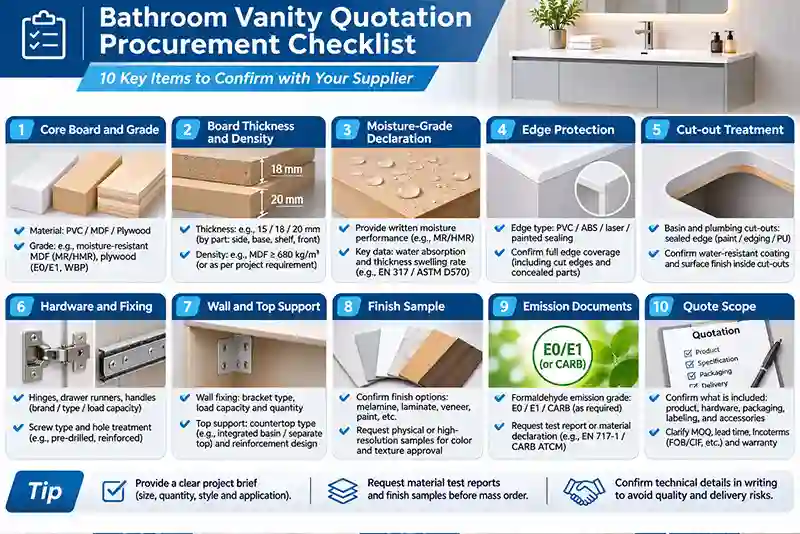
Table 6. Ten items to include in a vanity RFQ, why each matters, and the evidence to request.
| # | Item | Why it matters | Evidence to request |
|---|---|---|---|
| 1 | Core board and grade for each part | The carcass, back panel, doors and drawers can use different boards | Board list by part |
| 2 | Board thickness and density | Woodworking Network notes that MDF strength depends on thickness and panel density | Data sheet for each board |
| 3 | Moisture-grade declaration | A board name does not show the moisture class | EN 636 class, MDF.H declaration or PVC foam process |
| 4 | Edge banding | Cut edges let water reach plywood and MDF cores | Edge banding type and a cut sample |
| 5 | Cut-out treatment | Basin and waste holes expose the core | Sealing method for each cut-out |
| 6 | Hardware and fixing | Hinges and runners load the screw holes | Hardware model, plus inserts used in PVC board |
| 7 | Wall and top support | Heavy tops load the brackets and the carcass | Bracket type and reinforcement drawing |
| 8 | Finish sample and approved sample | The production finish must match the approved sample | Signed pre-production sample |
| 9 | Emission documents | Each destination market sets its own formaldehyde rules | The documents listed in Table 5 |
| 10 | Quote scope | Quotes differ when one includes a top, basin or mirror | List of included parts |
Use the same ten rows for every supplier you compare, so each quote prices the same build and the same documents.
No common test gives a reliable year figure for comparing PVC, MDF and plywood vanities. Service life in a bathroom depends more on water exposure, edge banding and hardware than on the board name. PVC foam board takes up very little water, and plywood tends to hold fixings better than MDF. Ask suppliers for warranty terms and test reports on the actual boards rather than lifespan claims.
The main trade-offs of PVC bathroom cabinets are hardware fixing and finish choice, not water uptake. Screw holding in PVC foam board depends on the board’s density and the inserts used. Ask the supplier how hinges and runners are fixed, and whether a loose screw can be fixed again. Finish choice depends on the film or the paint system the board maker approves.
A bathroom vanity does not need marine plywood by name, but the vanity does need plywood with a declared moisture class. BSI scopes BS 1088 to plywood intended mainly for marine craft. For a humid bathroom, ask for an EN 636-2 or EN 636-3 declaration on the actual board.
One vanity can combine a PVC or plywood carcass with MDF.H doors or drawer fronts. The supplier should state the board, thickness and grade for every part of a mixed build.
No single core wins every PVC vs MDF vs plywood choice for bathroom cabinets, because the answer depends on water exposure and hardware load. PVC foam board suits wet, poorly ventilated rooms, and humid-class plywood suits carcasses that need firm fixings. MDF.H suits painted doors in dry, ventilated zones where water rarely reaches the edges.
For PVC vs MDF vs plywood bathroom vanities, set one baseline, choose the core by the room’s water exposure, then confirm it with documents. The deciding documents are the moisture-grade declaration, the water absorption or swelling data, and the formaldehyde papers for your market.
Selecting the right cabinet core requires balancing durability, cost, and compliance. As a high-capacity, verified China supplier, Dlinxcy custom-engineers premium plywood bathroom vanities and high-density PVC foam board cabinets tailored exactly to international architectural specs.
Ready for a direct manufacturing quote? Send your custom sizes, total quantities, mounting specifications, and target market compliance needs to our engineering desk. We will return a line-item material solution within 24 hours.
Send Inquiry To Dlinxcy Experts