Contact Dlinxcy, Get Your Solutions!
Dlinxcy Supplies OEM & ODM Bathroom Vanity Sets, Bathroom Cabinet, LED Mirror, Mirror Cabinets Services for You. Contact us now for a Quote or Samples.
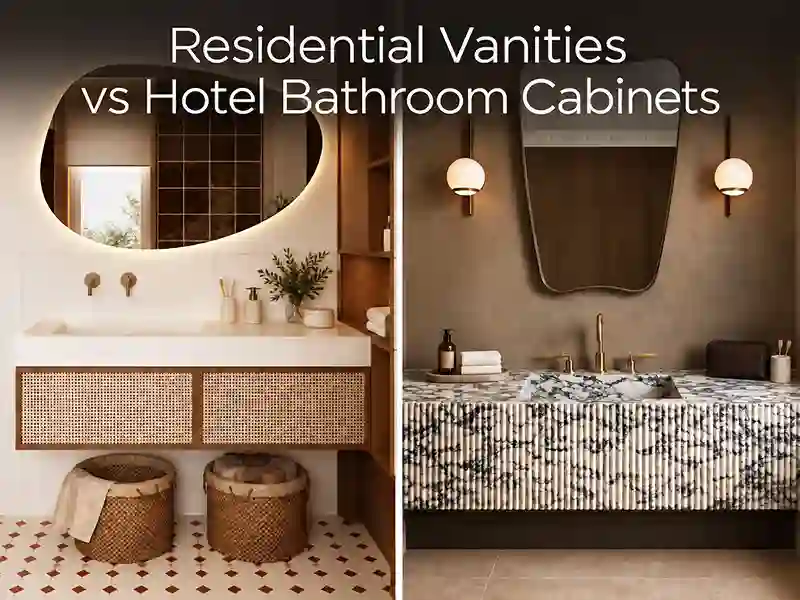
A residential bathroom vanity can sometimes work in a hotel guest room. But its marketing label nor its visual appeal guarantees it is fit for hospitality project use. Buyers should check the product’s construction, cleaning instructions, warranty, room fit, and access to parts before choosing it.
Key Takeaways
Not necessarily. In most cases, these labels reflect how a product is marketed and where it is installed rather than a standardized set of materials or engineering criteria.
Terminology can also vary across suppliers. The word “bathroom cabinet” can refer to more than the cabinet below a sink. It may also mean a wall cabinet, linen cabinet, or mirror cabinet. “Bathroom Vanity” may mean the cabinet alone or a set with a countertop, basin and LED Mirror. For a fair comparison, state what each product includes.
Note on Scope: This article compares bathroom cabinets used in homes and hotel guest rooms. It excludes high-traffic public hotel restrooms. Because a public restroom may have different traffic, layout, and service needs.
Purchase volume does not define the product either. A residential development project can order many bathroom vanities. A boutique hotel might order ten replacement unit. Terms such as “hotel-grade” and “commercial-grade” also need more detail. Always ask the bathroom vanity supplier to back up those labels with specific model numbers, material disclosures, test reports, and warranty clauses.
Want Know Bathroom Vanity Cabinet Manufacturer List in Gloabl? Click Here
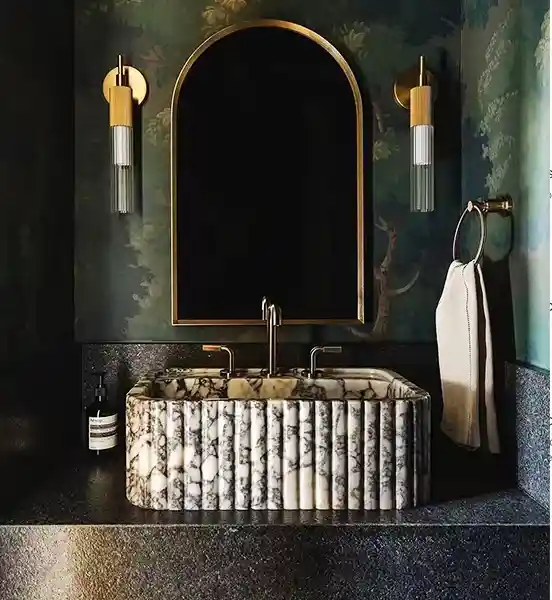
The real distinction between these two applications lies in how the product is managed over its lifecycle. A hotel buyer may need to review customer experience, cleaning routines, warranty coverage, access for repairs, and repeat orders. While a homeowner typically prioritizes personal storage capacity and interior aesthetics. Finally both buyers need a fixture that fits the physical footprint and withstands daily wear.
| Evaluation Area | Residential Bathroom | Hotel Guest Room | Key Verification Points |
| Usage & Storage | Daily family routines and long-term personal storage | Short-to-medium stays, luggage/wash bag placement, hotel amenities | Usable counter surface and unobstructed drawer/cabinet capacity |
| Cleaning & Care | Mild household cleaners and gentler routines | Daily turnover using commercial-grade disinfectants | Surface-specific care guidelines and chemical compatibility |
| Build & Hardware | Construction standards of the chosen retail model | Ability of that specific build to handle frequent guest turnover | Core materials, edge banding, joinery, hardware ratings, and test data |
| Fit & Maintenance | Room dimensions, existing plumbing, and basic access | Standardized layouts, rapid maintenance access, and component swap-outs | Technical drawings, rough-in locations, and door/drawer swing clearance |
| Warranty & Parts | Consumer purchase terms and basic customer support | Commercial coverage validity and traceable replacement parts | Commercial exclusions, SKU/part numbers, and ongoing stock availability |
| Sourcing & Cost | Bundled retail pricing for single or small orders | Phased deliveries, multiple room configurations, and bulk logistics | Apples-to-apples scope quotes and documented product specifications |
Treat this framework as a verification checklist rather than a quality ranking. If a supplier cannot provide a needed detail, mark it as unknown. Do not assuming the product meets “standard hotel expectations.”
Look beyond the board name. Check the cabinet core, finish, sealed edges, joints, cutouts, and connections. These parts face different conditions and may need different product records.
Moisture-resistant does not mean waterproof. For example, MEDITE states that its MEDITE MR panel is made for indoor humid conditions, but is not waterproof; the maker also says to avoid wetting the panel. This applies to that named panel, not to every MDF board or a finished vanity.
Ask whether a test or certificate covers a raw panel, a hardware part, or the complete cabinet. For example, the ANSI/KCMA A161.1-2022 standard outlines structural and finish performance tests for kitchen and bathroom cabinets, testing doors, drawers, and surface durability. However, a supplier merely mentioning this standard does not prove compliance—always request the actual test report and verify which model numbers it covers.
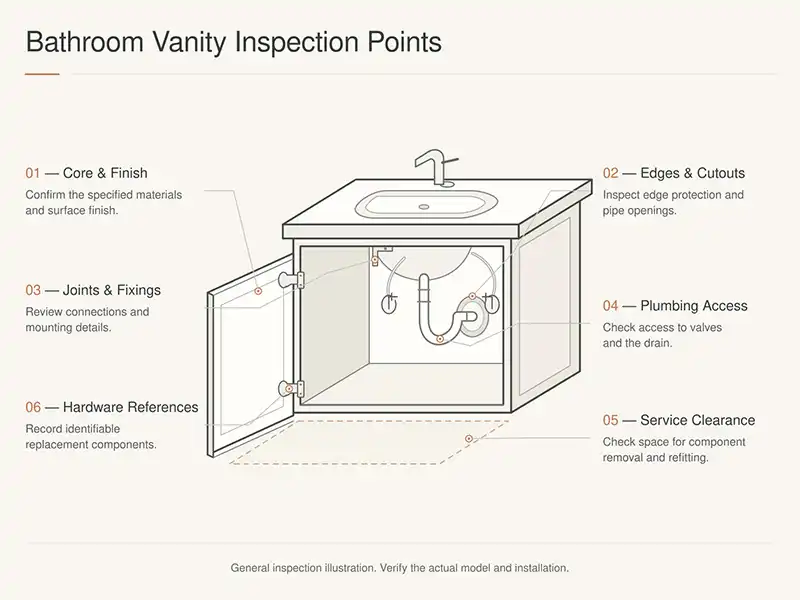
Check the planned cleaner against the care instructions for each surface. A vanity set may include a cabinet finish, countertop, basin, and metal parts. They may not share the same care limits.
Ask for the current instructions for the exact model. Confirm the cleaner, dilution, contact time, and wiping method where the product maker gives those details. Do not assume that a general chemical-resistance test covers every hotel cleaner or disinfectant.
Check whether staff or a service technician can reach the shutoff valves, drain, and hardware. Review the path needed to remove and reinstall the part. A removable hinge does not prove that a matching hinge will still be available later.
Ask for model and part numbers, as well as written information on parts support. A wall-hung design can affect floor access and service access, but it is not automatically easier to clean or repair. For details on wall support, pipe access, and wall-hung layouts, See Why Choose Wall-Hung Vanities for Hotel Bathrooms?.
Before specifying a residentially marketed bathroom vanity for a hotel project, scrutinize the warranty fine print. . Look for permitted use, covered defects, claim requirements, labor, removal, reinstallation, and exclusions.
Many consumer brands strictly exclude commercial installations. For example, Avanity current warranty page limits coverage to normal residential use and excludes products used in commercial or other non-residential settings. If the product is installed in commercial or hospitality settings. This is one brand’s policy. It does not set the rule for every vanity maker.
A warranty term alone does not show what a buyer will receive if a part fails. Read the exclusions and ask the maker to confirm hotel use in writing.
Compare quotes with the same list of included items. One quote may cover only the cabinet, while another may include the top, basin, hardware, and packing. List transport and installation separately if they are part of the project.
A hotel label does not show whether a product costs more or less. Without quotes for the same product scope, quantity, destination, and delivery terms, a price comparison may leave out key costs.
If the project has several room layouts or may need future replacements, record the model, finish reference, drawings, hardware, and included parts. These records help the buyer identify what was approved. They do not promise a perfect color match or continued supply.
For questions about samples, specifications, and repeat project supply, See Our hotel vanity OEM/ODM sourcing guide.
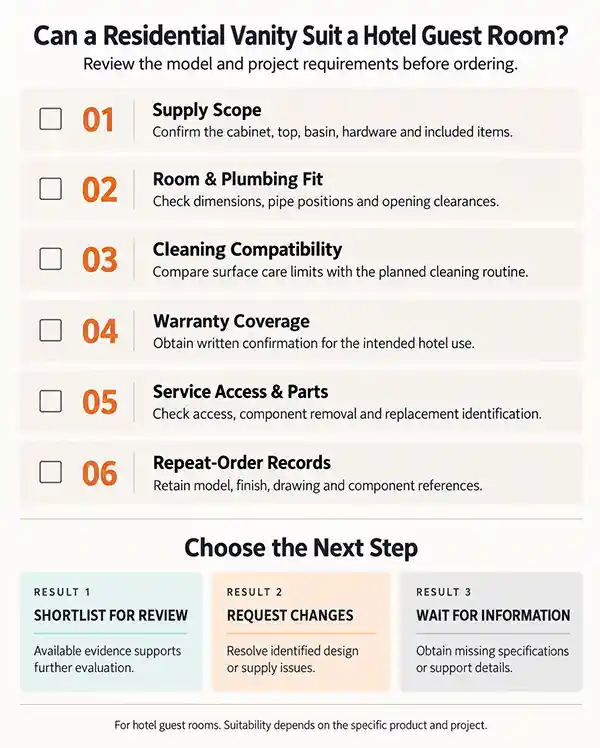
Yes, a residential vanity can be considered for a hotel guest room. The decision depends on the model and project conditions, not the product label.
Use one of three outcomes:
Keep it on the shortlist:
The size, construction, care instructions, and warranty fit the project, and the needed records are available.
Revise it before approval:
The design may work, but the layout, plumbing access, finish, hardware, or supply details need changes.
Hold the decision:
Key information is missing, such as product dimensions, care limits, commercial-use terms, or parts details.
Before approval, confirm:
Whether the quote covers the same cabinet, top, basin, and hardware.
Whether the vanity fits the room, plumbing, and door or drawer swing.
Whether the care instructions match the hotel’s planned cleaning products.
Whether the warranty covers the intended use.
Whether staff can reach service points and identify replacement parts.
Whether any repeat-order details are recorded.
Yes, they can be considered if the specific model meets the spatial and operational demands of the guest room and the manufacturer validates its use for hospitality. Check the warranty, care instructions, construction, plumbing access, and parts support before approval.
Not necessarily. “Commercial-grade” is an loosely defined marketing term rather than a universal engineering standard. Rather than relying on labels, hospitality buyers should define their exact environmental and operational needs, then request model-specific construction details and test reports from the supplier.
The label alone cannot answer that. Compare the cabinet construction, hardware, finish, use conditions, and test records for the exact products. There is not enough comparable evidence here to state a fixed lifespan difference.
It can. Warranty terms differ by maker and model. Some policies limit coverage to residential use, so get written confirmation for the intended hotel use.
That depends on the cabinet design and whether the needed part is available. Check the service path, part number, and replacement terms for the exact model.
Do not assume that every vanity in every hotel room follows the same requirement. For U.S. projects, confirm which rooms and spaces are covered, then review the full lavatory setup with the project’s qualified design or code professional.
The right bathroom vanity and cabinet is the one that fits the room and the work around it. A residential model may suit a hotel, while a product sold as “hotel-grade” may still leave questions unanswered.
Keep a suitable design on the shortlist, but approve the exact model only when its care limits, warranty, installation, and parts support are clear. If a missing answer could change your choice, resolve it before ordering
Are You Looking Residential Vanities and Hotel Bathroom Vanities Project OEM Solutions? Dlinxcy as Bahtroom Vanity Suppliers, We Supplies Custom OEM Solutions for Hospitality and Residential Development Projects.
Related Article:
Send Inquiry To Dlinxcy Experts