Contact Dlinxcy, Get Your Solutions!
Dlinxcy Supplies OEM & ODM Bathroom Vanity Sets, Bathroom Cabinet, LED Mirror, Mirror Cabinets Services for You. Contact us now for a Quote or Samples.
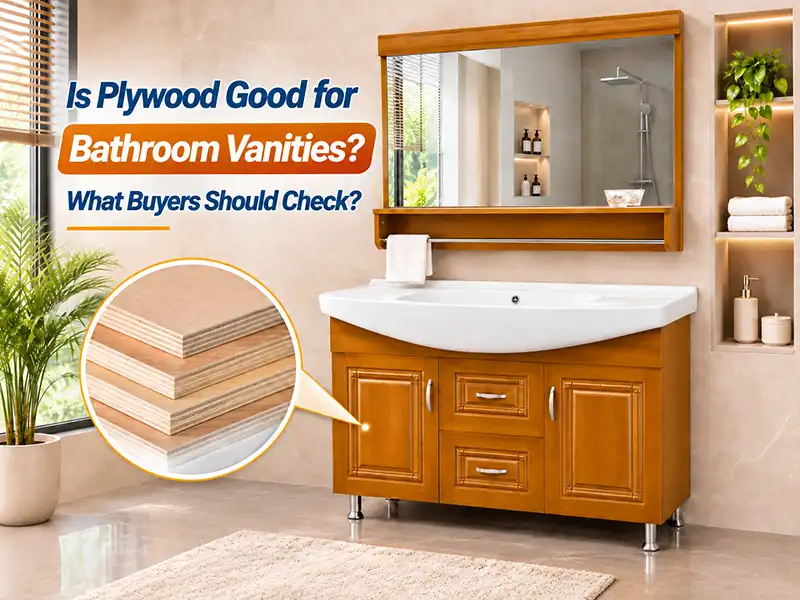
Yes, plywood is good for bathroom vanities when three things are right: the panel carries a humid or exterior bond class, every cut edge and cut-out is sealed, and the face has a finish that suits wet rooms. Plywood holds screws well and stays flatter than solid wood. It still takes up water through open edges, so buyers should check the grade, the edges and the finish in writing before ordering.
Our guide covers plywood bathroom vanities only. For a side-by-side view of three cabinet cores, read our PVC vs MDF vs plywood bathroom vanities comparison.
Key takeaways:
Plywood works for a bathroom vanity when the panel grade, the edge sealing and the surface finish are all specified for a humid room. Each layer covers a different weak point, so a cabinet that gets one layer right and skips another can still swell. Plywood is a panel made of thin wood veneers glued in layers, with the grain of each layer turned across the one below. That cross-laminated build helps it resist warping, cracking and splitting better than solid boards.
A plywood vanity handles bathroom moisture through three layers: the bond class of the core, the sealing of edges and holes, and the face finish. The bond class describes how well the glue lines hold when the panel gets damp. Edge banding and cut-out sealing keep water away from the open core. The finish keeps splashes and cleaning water off the panel face.
A buyer should read the three layers as one system. A humid-grade core with bare cut edges still takes up water at those edges. A good melamine face on a dry-use core still depends on glue lines that were never meant for damp rooms.
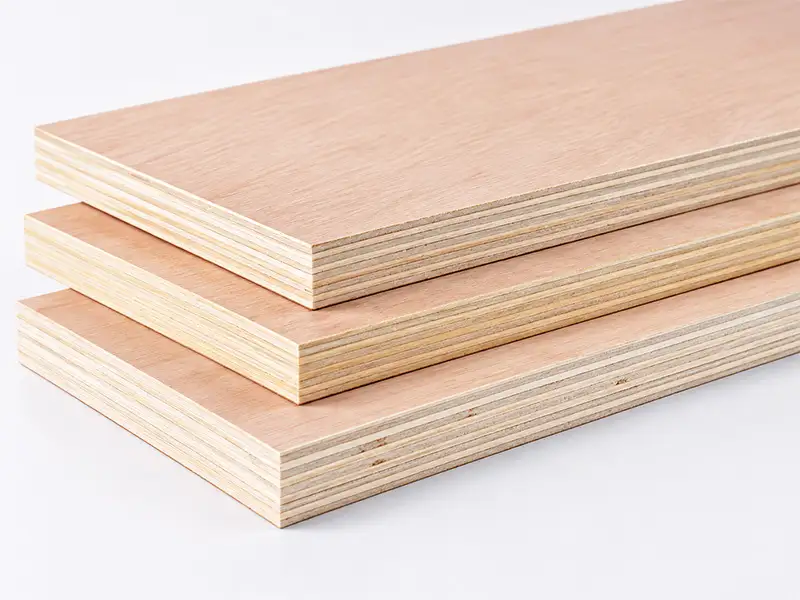
Two plywood vanities can look the same and still age differently in a bathroom, because the difference sits inside the cabinet. The word “plywood” on a quote names the material, not its grade.
Example: Two 900 mm (36 in) wall-hung bathroom vanities have the same walnut melamine finish. Supplier A quotes an EN 636-2 core, banding on every edge and sealed basin and waste holes. Supplier B quotes “plywood” with no class, banding on the visible edges only, and raw cut-outs. Supplier B’s cabinet costs less because it skips work that buyers rarely see on a showroom sample. The base and the cut-outs of that cabinet face a higher risk of swelling once water reaches them.
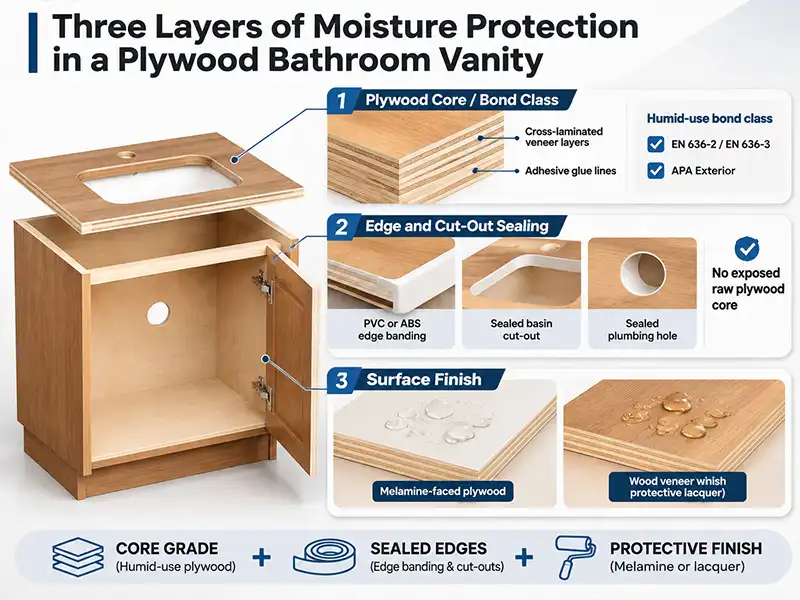
Water rarely gets into a plywood vanity through an intact, finished panel face. It gets in through cut edges, drilled holes, screw holes and damaged finish, so those are the places to check first. Most of these points sit low in the cabinet or close to the plumbing.
Water reaches a plywood cabinet core at five common points:
The same five points are the items a buyer should check on a sample or in a specification sheet before placing an order.
When water reaches the core, plywood swells, and the swelling is uneven because the wet edge takes up water faster than the dry middle. A BS 1088 marine plywood scope note from BSI warns that fast water entry at a panel edge can make the core swell unevenly and break wood fibers, which can look like delamination. The same note applies the warning to marine plywood, so a premium grade does not remove the need for edge sealing.
Repeated wetting also tests the glue lines. A core with a dry-use bond class is more likely to show glue failure than a humid or exterior class. Rot depends on the wood species, the moisture level and how long the panel stays wet, so a plywood cabinet that dries out after a splash does not rot from that splash.
Common mistake: Inspecting the door and the top of a sample but not the base and back panel. The base and back panel sit closest to leaks, so ask for their board type and edge treatment in writing. A swollen cabinet base is one of the common bathroom vanity problems that starts at these hidden edges.
The best plywood grade for a bathroom vanity is a humid-use or exterior-use bond class, such as EN 636-2 or EN 636-3 in Europe, or APA Exterior in North America. A grade in this sense describes the glue bond and the service condition the panel is made for. It is not a wood species, and it is not a face appearance grade. A dry-use class suits wardrobes and living room furniture, not a cabinet under a basin. When buyers compare plywood grades for cabinets, the bond class is the line to read first.
EN 636 is the European plywood specification that sorts panels by the conditions they are made for. EN 636-1 covers dry conditions, EN 636-2 covers humid conditions, and EN 636-3 covers exterior conditions. A plywood data sheet from the dataholz.eu building materials database maps these classes to service classes 1, 1 to 2, and 1 to 3 under Eurocode 5.
For a bathroom vanity, EN 636-2 is the usual starting point and EN 636-3 gives more margin. The EN 636-3 class mainly describes glue-line performance, not the natural durability of the wood itself. “WBP” is an older test name that suppliers still use, but it is no longer a term in current British or European standards.
What to ask your supplier: Write “EN 636-2” or “EN 636-3” on the quote for each cabinet part. Do not accept “WBP” alone as the grade.
APA grades plywood for moisture with two bond classifications. Exterior panels are made for permanent exposure to weather or moisture. Exposure 1 panels are made to handle moisture during construction delays, not long-term outdoor exposure. The common CDX label belongs to the Exposure 1 group, not the Exterior group. APA also explains that APA-trademarked structural plywood is made with phenolic adhesives rather than urea-formaldehyde, because urea-formaldehyde is not water resistant enough for structural panels.
What to ask your supplier: For the US market, ask for “APA Exterior” panels, or Exposure 1 panels with every edge and cut-out sealed. Ask which adhesive the panel uses, because the APA statement covers APA-trademarked structural panels, not every decorative cabinet panel.
Marine plywood made to BS 1088 is a boat-building specification, not a cabinet grade. The standard focuses on resistance to biological decay and on glue strength over time. It does not cover other properties a vanity may need, such as flatness or finish performance. Marine plywood can be used in a vanity, but a bathroom does not require it.
What to ask your supplier: If a supplier offers marine plywood, ask for the standard it was made to and the price difference against an EN 636-2 panel.
| System | Dry conditions | Humid conditions | Exterior conditions | Bathroom vanity choice |
|---|---|---|---|---|
| EN 636 (Europe) | EN 636-1 | EN 636-2 | EN 636-3 | EN 636-2 or EN 636-3 |
| APA (North America) | Not a bond class | Exposure 1 | Exterior | Exterior, or Exposure 1 with sealed edges |
| BS 1088 (marine) | Not covered | Not covered | Marine plywood | Optional, not required |
Not sure which grade your supplier is quoting? Send us your project details and Dlinxcy can check the plywood class and edge sealing on your specification sheet before you order.
A plywood vanity becomes moisture-resistant when its edges are banded, its cut-outs are sealed, and its face finish covers the panel. The grade decides how the glue holds. These three details decide how much water reaches the glue in the first place.
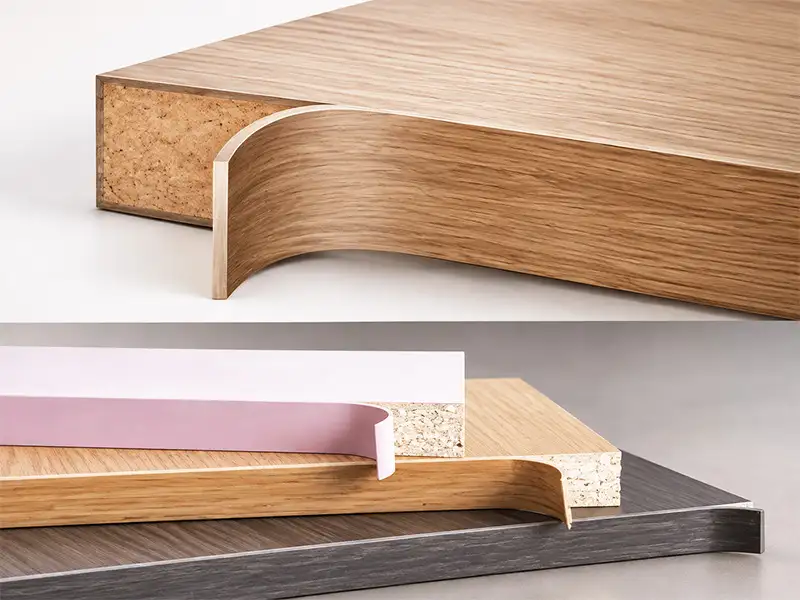
Edge banding is a thin strip glued over the cut edge of a panel to close the core. PVC and ABS edge banding are plastic strips that take up very little water. Veneer edge banding matches the wood face, but it needs the same lacquer as the face to resist water.
Every edge that can meet water needs banding: the carcass edges, all four door edges, drawer fronts and exposed shelves. Factories sometimes skip the back panel edges and the inner edge of the cabinet base, because buyers do not see them. Those two edges sit closest to leaks.
What to ask your supplier: Ask for a sample marked with the banding material and thickness used on each edge, and sign it off before mass production, as in our sample approval process.
Basin and pipe cut-outs are the largest single water risk in a plywood vanity, because they expose the core right next to the plumbing. Common treatments include silicone sealant, edge banding around the opening, and a sealing coat on the cut face. A cut-out left raw after drilling does not meet a bathroom specification.
What to ask your supplier: Ask for photos of the cut-outs before and after sealing. If your current supplier cannot show cut-out sealing photos from past orders, treat that as a warning sign.
Most plywood bathroom vanities use one of two finishes: a melamine face or a wood veneer face with clear lacquer. Both finishes protect the panel face, and both depend on edge banding for the cut edges.
A melamine-faced panel is a board pressed with a decorative paper that has been soaked in melamine resin. The cured surface is hard, wipes clean and takes up very little water, so the panel needs no further coating. Melamine covers only the faces of the board, so every cut edge still needs PVC or ABS banding and every hole still needs sealing. The usual failure points are lifted banding, chipped corners and raw cut-outs.
A wood veneer face is a thin slice of real wood, or engineered wood, glued to the plywood. The veneer itself takes up moisture, so its water resistance comes from the lacquer on top. Ask which lacquer the factory uses, and whether it covers the front, the back and the edges of each part. In the AWI finishing system comparison, nitrocellulose lacquer is noted for low resistance to water. Conversion varnish, catalyzed polyurethane and UV-curable systems carry much higher performance scores.
A 2021 study on wood finishes in bathrooms found that penetrating coatings gave some protection against liquid water but very little against water vapor. That result was measured on ash and larch, not on plywood cabinets. It still shows why a film-forming lacquer on all faces suits a bathroom better than an oil.
Spraying a “waterproof” paint over plywood does not replace edge banding or cut-out sealing. A coating slows how fast the face takes up moisture, but it cannot stop water at an unsealed cut edge. High-pressure laminate (HPL) and painted plywood are also possible, but they are not standard finishes for plywood vanities. Confirm the cost and process with the factory if a project needs them.
| Finish | What the face protects | What protects the cut edges | What the supplier should state |
|---|---|---|---|
| Melamine-faced plywood | Splashes and wiping on the panel face | PVC or ABS edge banding, plus sealed cut-outs | Decor name, edge banding material, cut-out treatment |
| Wood veneer with clear lacquer | The lacquer seals the veneer face | Lacquer over the edges, edge banding, sealed cut-outs | Veneer species, lacquer type, whether front, back and edges are coated |
At Dlinxcy, plywood vanities are usually supplied with melamine or wood veneer finishes. Send your preferred finish, and we will confirm the edge and cut-out details for that finish. You can also see how finished cabinets are inspected on our quality control page.
The three Dlinxcy plywood vanities below show how a specification sheet states the finish, size and hardware. Use them as a reference for what to ask any supplier.
| Model | Cabinet size (W x D x H) | Finish | Storage and hardware | Top and basin |
|---|---|---|---|---|
| KL813020-150 floating vanity | 800 to 1500 x 500 x 442 mm | 10298-57 walnut melamine | Three finger-pull drawers, Unihopper metal box soft-closing slides | Alpine White sintered stone top, ceramic countertop basin |
| AS813048A / AS813048B fluted vanity | 610 to 1210 x 460 x 565 mm | Ancora Walnut lacquered and melamine | Four drawers, Unihopper metal box soft-closing slides | Glossy white ceramic basin |
| DBV08 600 mm vanity | 600 x 380 x 380 mm | Acacia lacquered and melamine | Three doors, Unihopper soft-closing hardware | Glossy white ceramic basin or sintered stone integral basin |
Engineering note: A finish name on a product page describes the look, not the build. For any vanity, ask which parts carry the melamine, which carry the lacquered veneer, and how the edges of each part are closed.
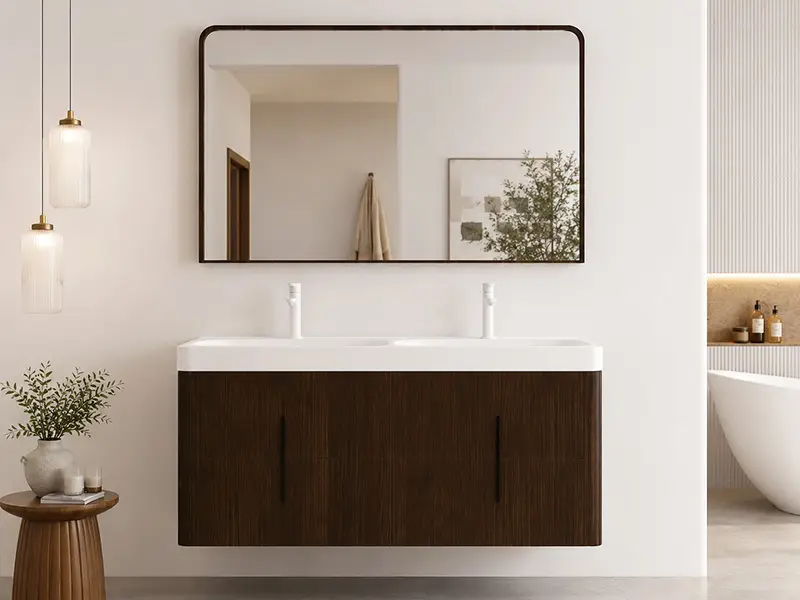
Plywood is not the best fit for every bathroom environment, and four situations call for a different material or a different plan.
Room conditions also decide warranty cover. Our warranty and after-sales terms cover factory-related swelling and delamination of plywood cabinet bodies. They do not cover damage from long-term standing water, plumbing leaks, poor ventilation or abnormal humidity.
If a project does not fall into these four cases, plywood with the right grade and sealed edges is a sound choice.
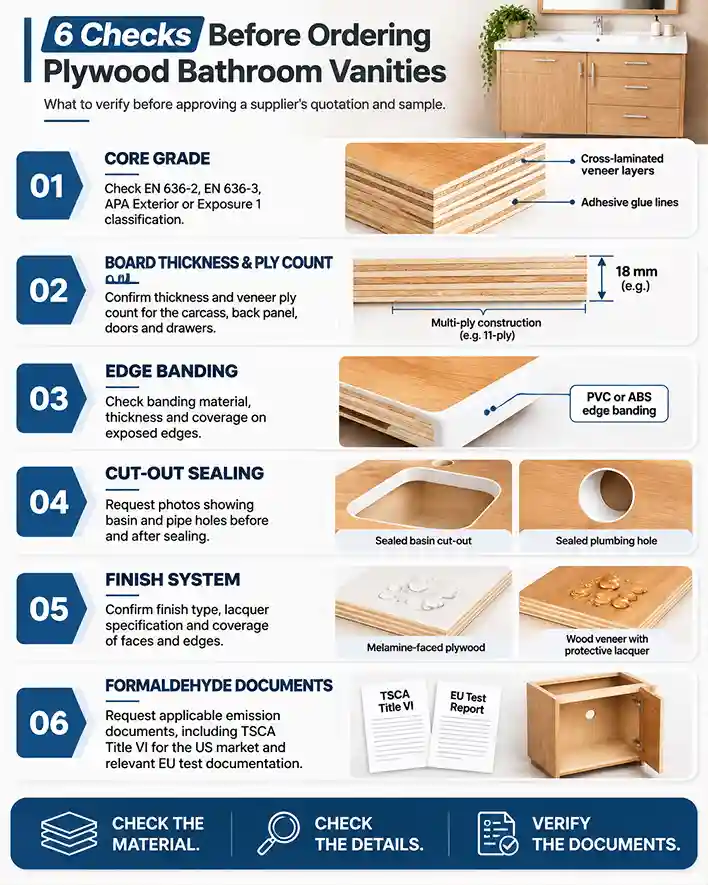
Before ordering plywood bathroom vanities, put six plywood-specific checks into your request for quotation (RFQ) and compare each supplier’s answers line by line. Each check turns a condition from this guide into a document or sample the supplier can provide.
| Check | Why it matters | What to ask the supplier for |
|---|---|---|
| Core grade | “Plywood” is a material name, not a grade | EN 636-2 or EN 636-3 declaration, or APA Exterior or Exposure 1 grade |
| Board thickness and plies | Thin parts hold screws and loads less well | Thickness and ply count for the carcass, back panel, doors and drawers |
| Edge banding sample | Cut edges are the main water path | Banding material (PVC, ABS or veneer), thickness, and a cut sample |
| Cut-out sealing | Raw holes take up water fast | Photos of basin and pipe cut-outs before and after sealing |
| Finish system | Melamine and lacquered veneer protect the panel in different ways | Finish type, veneer species and lacquer type, coverage of back faces and edges |
| Formaldehyde documents | Each market sets its own rules | TSCA Title VI label for the US, emission test report for the EU |
For the US market, hardwood plywood must meet the TSCA Title VI formaldehyde emission limit of 0.05 ppm. In the EU, Regulation (EU) 2023/1464 bars furniture that releases more than 0.062 mg/m³ of formaldehyde under its set test conditions after 6 August 2026. Ask for the label or test report that covers the actual product you are buying.
Not sure how to read a plywood specification sheet or a grade declaration? Send your RFQ draft to Dlinxcy, and we will review the plywood class, edge banding and emission documents before you finalize the order.
Yes, plywood can be damaged by water when water reaches the core and stays there. The core swells, and repeated wetting can weaken the glue lines. A humid or exterior bond class with sealed edges handles splashes that are wiped dry. No plywood grade handles a slow leak that keeps the cabinet base wet. See where water gets into a plywood vanity above.
Plywood is usually better for the parts of a bathroom vanity that carry load, while moisture-resistant MDF gives a smoother painted door. Plywood holds screws well, which suits top supports and wall-hung rails. Many cabinets mix the two materials. However, in the humid environment of a bathroom, plywood bathroom vanities are more suitable than MDF bathroom vanities.
Plywood is usually more stable than solid wood in a bathroom, because its cross-laminated layers limit warping and splitting. Solid wood moves more across the grain as the humidity changes. Solid wood can still suit a premium vanity with a durable species, stable joinery and a full lacquer seal. Many cabinets combine the two, so ask which parts are solid wood and which are plywood.
No, a bathroom vanity does not need marine plywood. Marine plywood made to BS 1088 is a boat-building specification focused on decay resistance and long-term glue strength. A humid-class panel such as EN 636-2, with sealed edges and cut-outs, is the usual choice for a vanity. If a supplier offers marine plywood, ask for the standard and the price difference.
A plywood bathroom vanity has no fixed lifespan, because its life depends on the panel grade, edge sealing, leaks and ventilation. A cabinet with a wet base or lifted banding can start to swell within months. Warranty is a separate question. Dlinxcy’s warranty terms give 5 years on the cabinet structure, 3 years on hinges and 2 years on electrical parts.
No. Melamine plywood is moisture-resistant, not waterproof. The melamine face protects only panel surfaces; cut edges, basin holes, and pipe holes must be sealed. Dlinxcy factory team says “about 90% waterproof performance,” but the original claim is “about 90% with sealed edges”—a conditional estimate, not an unconditional waterproof rating.
No plywood is fully waterproof. The most moisture-resistant panels carry an exterior bond class, such as EN 636-3 or APA Exterior, because their glue lines hold up under long-term wetting. These panels still take up water at open edges and need edge banding. Water resistance belongs to the whole cabinet build, not to the panel name alone.
Is plywood good for bathroom vanities? Yes, when the panel has a humid or exterior bond class and the edges and cut-outs are sealed. The melamine or lacquered veneer finish then protects the panel faces. Use the six checks above to compare suppliers on the same build.
Are You Want to Custom Plywood Bahtroom Vanities? Send Dlinxcy your sizes, quantities, mounting type, preferred finish and destination market. Dlinxcy supplies OEM various bathroom vanities, LED Mirror, Mirror cabient for your bathroom project. Browse our bathroom vanities Collection. For countertop and basin choices problems, see our bathroom vanity material buying guide.
Send Inquiry To Dlinxcy Experts