Contact Dlinxcy, Get Your Solutions!
Dlinxcy Supplies OEM & ODM Bathroom Vanity Sets, Bathroom Cabinet, LED Mirror, Mirror Cabinets Services for You. Contact us now for a Quote or Samples.
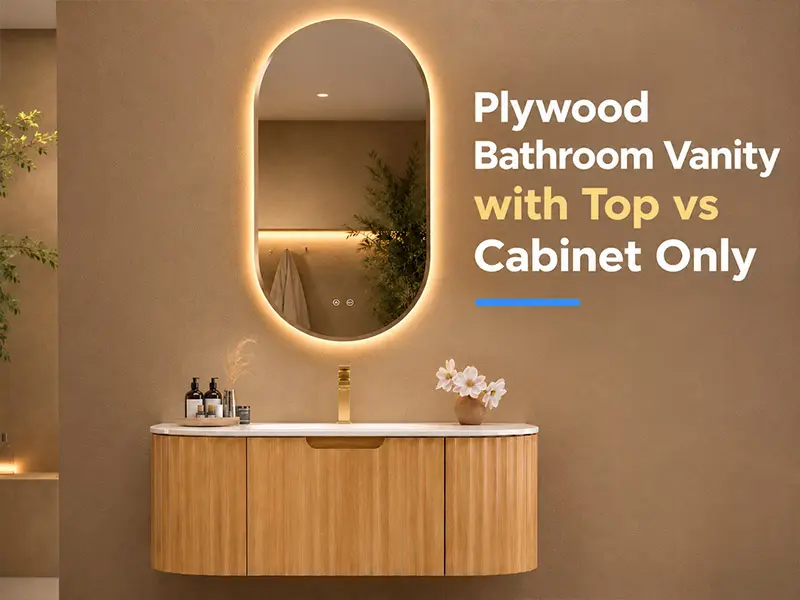
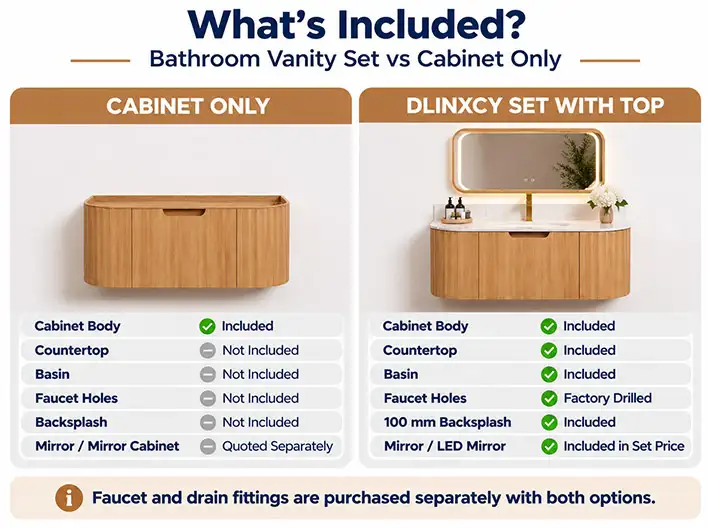
In a bathroom vanity with top vs cabinet only, the set adds the countertop, basin and drilled faucet holes, and our factory bathroom vanity set also covers a mirror cabinet or LED mirror. The cabinet only stops at the box, doors, drawers and hardware. The faucet and drain fittings are bought separately in both cases. Choose the set when one supplier specifies the top and mirror, and compare both quotes line by line first.
For the price tiers behind a plywood bathroom vanity with top, see Plywood Bathroom Vanity Cost: Wholesale & Custom Pricing.
Key takeaways
A plywood vanity set includes the cabinet, the countertop, the basin and drilled faucet holes. A cabinet only includes the box, doors, drawers and hardware. Our set price also covers a mirror cabinet or an LED mirror, which a cabinet-only quote leaves out
When comparing a bathroom vanity with or without top, a cabinet only is also called a base only or a vanity without top. US retailers describe it as the cabinet without a top, sink, faucet or backsplash. The label alone does not fix what a “with top” package contains, so read each line of the quote.
Table 1. Supply scope of a cabinet-only quote and our plywood vanity set, with what the buyer confirms for each item.
| Item | Cabinet only | Dlinxcy set with top | What to confirm |
| Cabinet (box, doors, drawers, hardware) | Included | Included | Size, finish, hardware |
| Countertop | Not included | Included; the standard top is ceramic with an integrated basin, and man-made marble or sintered stone are upgrade options | Top material and edge |
| Basin | Not included | Included with the top | Basin type and drain position |
| Faucet holes | None; the drilling follows the top you source | Drilled at the factory, never on site | Single hole or three holes, and the spacing |
| Backsplash | Not included | 100 mm in the same material as the top; can be deleted for a lower price | Keep or delete |
| Faucet | Not included | Not included; Dlinxcy does not make faucets | Match the hole layout |
| Drain fittings | Not included | Not included; bought locally | Drain position, fixed before production |
| Mirror or mirror cabinet | Quoted separately | Included in the set price | Mirror type and width |
| Export packing | Stated in the quote | Included in the FOB price of the A and B styles | Carton split and loading port |
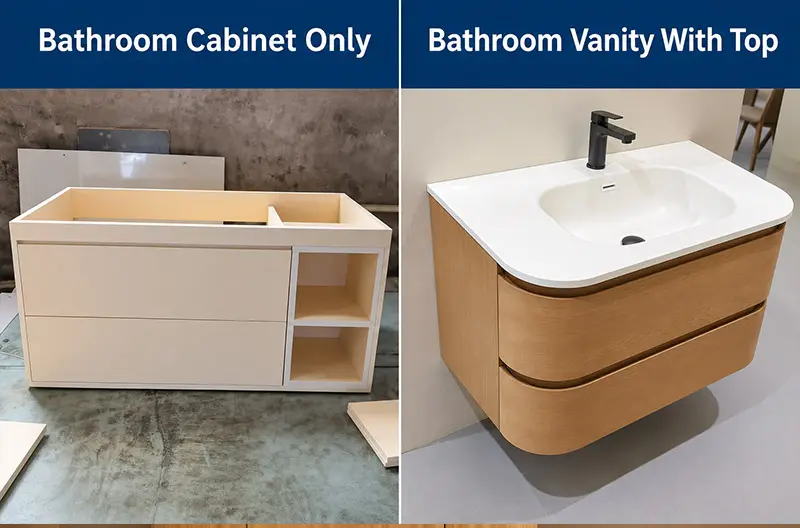
The mirror is the line a reader can overlook, because the word “top” in a title does not mention it. We also supply the lower cabinet without the mirror, and that unit is quoted on its own. Our factory can supply the cabinet body without a top as well, and the price gap depends on the top type. The minimum order is 20 pcs, whether the order is whole sets or the cabinet body alone.
The drain hole position needs a decision before production, because it cannot be moved after the factory cuts the basin and cabinet. The same applies to the faucet holes in a factory-drilled top. Plywood is not fully waterproof, so seals its edges against moisture.
They overlap, but the UK term usually covers more parts. In the US, “with top” normally means a cabinet plus a top that often has the basin cast in. One UK retailer lists a vanity unit set as the unit, basin, worktop, waste fitting and mirror, with the tap sold separately in most sets.
A worktop is the UK word for a countertop, a basin is a sink, and a tap is a faucet. A buyer shipping to both markets should write the part list in the quote instead of relying on the set name.
Choose a set with top when one supplier specifies the top and the mirror, and a cabinet only when another party specifies them. A set gives one quote and one delivery, but the top comes from the supplier’s range. At Dlinxcy the standard top is ceramic with an integrated basin, and man-made marble and sintered stone are upgrades. A cabinet only gives free choice of the top, at the cost of sourcing and fitting it yourself.
Table 2. Conditions that favor a set with top or a cabinet only, with what each choice leaves to the buyer.
| Situation | Better fit | What it leaves to the buyer |
| Repeated layout, such as hotel standard rooms or apartment blocks | Set with top | Confirm the top, basin and mirror once per layout |
| One quote and one delivery are needed | Set with top | Confirm the faucet and drain fittings |
| The ceramic integrated-basin top is acceptable | Set with top | Choose the faucet to match the holes |
| A designer has specified a stone top or a special basin | Cabinet only | Source, cut and fit the top locally |
| A local fabricator supplies the top | Cabinet only | Send the top size, overhang and drilling to the supplier |
| A brand sells its own tops and mirrors | Cabinet only | Match the top to the cabinet width and depth |
The top should be decided before the cabinet width and drilling are fixed. A common question from remodelers is whether to choose the top first, because a cabinet bought early can leave no suitable top size. In a project, the top specification therefore goes to the supplier together with the cabinet order.
We can supply the cabinet alone, so a project that sources its own tops does not need the full set. A project that wants the set’s ceramic top with a different basin shape or material should ask for the upgrade options before ordering. Send Your Plywood Bathroom Vanity Need?
A bathroom vanity top has to match the cabinet in width and overhang, the backsplash in height, and the faucet in hole spacing. The holes are the least forgiving, because a top drilled for one faucet layout cannot take another. Table 3 lists the five items a buyer confirms before the top is ordered.
Table 3. standard top-to-cabinet fit and faucet drilling, with what the buyer confirms for each item.
| Item | Dlinxcy standard | What the buyer confirms |
| Top width | 25 mm (approx. 1 in) wider than the cabinet | Total top width against the cabinet width |
| Front overhang | 25 mm (approx. 1 in) beyond the cabinet front | That the overhang clears doors and drawer fronts |
| Backsplash | 100 mm (approx. 3.9 in), same material as the top; can be deleted | Keep or delete |
| Faucet holes | Drilled at the factory; single hole Ø35 mm (1.38 in) centered, or three holes Ø32 mm (1.26 in) at 100 mm (3.9 in) or 200 mm (7.9 in) spacing | The faucet model, or its hole spacing |
| Drilling position | Factory only, none on site; hole count, spacing and offset can follow a drawing | The approved drawing, before production |
These are our standard values, and a custom top follows the confirmed drawing. The buyer should not apply a US stock size such as a 22 in top on a 21 in cabinet to them. A buyer who orders a top elsewhere sends the supplier the top size, the overhang and the drilling, so the doors and drawers clear it.
Faucet hole spacing fixes the faucet type, because the holes are drilled before the faucet is chosen. A faucet maker’s guide states that three holes with handle centers 4 in apart take a centerset faucet, and three holes 8 to 16 in apart take a widespread faucet. The two types cannot be swapped. A single hole takes a single-hole faucet, and the faucet’s specification sheet says whether it needs a base plate.
Our standard three-hole spacing is 100 mm or 200 mm, chosen for the customer’s market. That is roughly 3.9 in and 7.9 in, close to but not the same as the 4 in and 8 in sizes above. A US buyer therefore sends the faucet model or its hole spacing with the order, and the drilling follows that drawing.
Drill the faucet holes at the factory and none on site. A cut made after sample approval exposes core that no factory process has treated, which is why every cut-out needs a named owner. The edge-sealing guide explains who seals each cut-out and how to check it.
A stone top adds a second reason. Cutting and drilling stone on site produces respirable crystalline silica dust, which OSHA and NIOSH identify as a health hazard for workers in shops and on site. A workshop is easier to equip for dust control than a bathroom.
Project specification check: Send your faucet specification sheet or cabinet schedule via Dlinxcy website to confirm factory hole spacing and line-item pricing before production.
A plywood cabinet can support a stone top only when the structure under the top is designed for that load, and the plywood name alone does not answer the question. The deciding factors are the top’s weight, the support under it, and whether the cabinet is floor-standing or wall-hung. A stone top is heavier than a ceramic one, so the support check changes when the top is an upgrade.
The US cabinet standard does not settle the matter. KCMA A161.1-2022 covers factory-assembled kitchen and vanity cabinets, but it is a performance and construction standard that does not specify cabinet design or materials. A cabinet built to it does not automatically carry a stone top.
Top weight depends on the material and thickness. Cambria’s specification sheet lists 5, 10 and 15 lb/ft² for its 1, 2 and 3 cm quartz surfaces, using ASTM C-97. That figure covers only Cambria’s quartz, so a granite, sintered stone or ceramic top needs its own weight from the maker.
Under the top, Dlinxcy lays 18 mm multi-layer board over the full area and adds metal cross-members, so the load does not rest on the top itself. We have run a static vertical load test on the top: 1,000 N through a 100 × 100 mm rigid pad, applied 10 times and held for 10 s each time. The pass criteria are no breakage, no permanent loosening and no deformation that affects use.
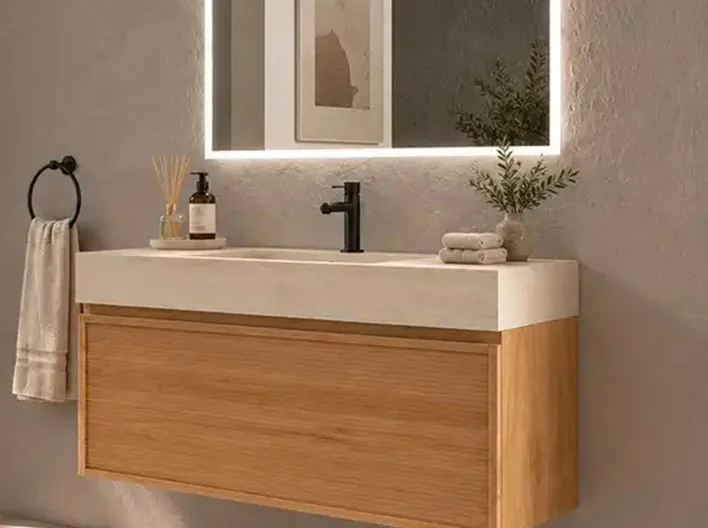
A 1,000 N static load on the top is a test method that appears in both China’s bathroom furniture standard and the European standard for kitchen and bathroom storage units. GB/T 24977-2024 was issued on 29 June 2024, took effect on 1 January 2025, and replaces GB 24977-2010. BS EN 14749:2016+A1:2022 is current and covers bathroom storage units. The two are separate documents from separate markets, so a buyer asks which one a test report cites.
For project specifications, our factory can add a test at 1.5 kN held for 1 h, with a loaded deflection of at most 2 mm and a residual of at most 0.3 mm 30 min after unloading. That is a project specification and not a requirement of either standard.
A buyer who plans a stone top checks five points with the supplier:
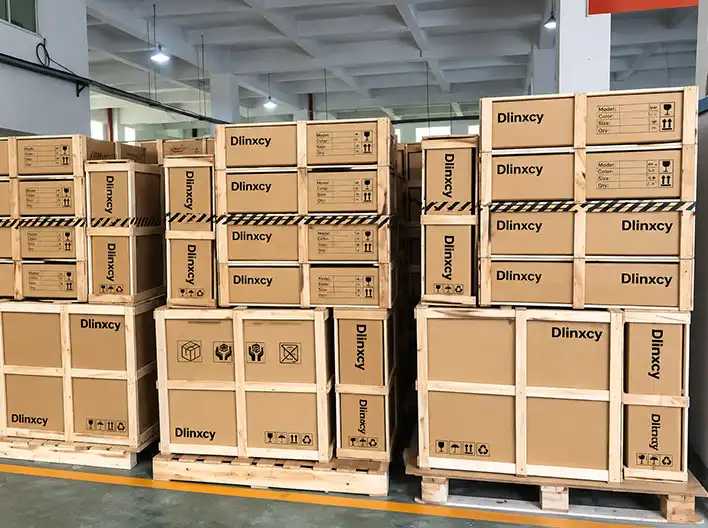
A top can ship in the cabinet’s carton or in its own, and the choice trades assembly time against freight. A shared box saves assembly time, and separate boxes save freight. Our factory uses standard export packing in both cases.
In a shared box, the top should never sit at the bottom, because the cabinet, hardware and the weight of stacked cartons press on it. There are two workable layouts. In the first, the top stands on its edge along one side of the box and a rigid board separates it from the cabinet, either 5 mm corrugated board or 3 mm density board. This is the most stable layout, but it widens the box, and that extra width is why a shared box takes more container volume.
In the second layout, the top gets its own inner carton, which is placed inside the outer box against one side. This layout switches easily between shared and separate boxes, and it lets a damaged top be claimed on its own. A buyer who pays for freight by volume prefers separate boxes, and a buyer who installs on site with a small crew prefers one shared box. The packing and logistics page describes our general export packing.
The price gap between a with-top quote and a cabinet-only quote is the lines one quote leaves out, and it has no fixed percentage. A set includes the top, basin, drilling, backsplash and mirror, while a cabinet-only quote includes none of them. The gap is only meaningful after both quotes list the same lines.
Dlinxcy quotes the set with the countertop, basin and mirror cabinet or LED mirror, and the faucet is bought separately. The lower cabinet without the mirror is quoted on its own, and a cabinet without a top can also be supplied alone. The price of a cabinet without a top depends on the top type, so the buyer asks for a line-item price for each top option. The minimum order is 20 pcs for a whole set or for the cabinet body alone.
For example: Two suppliers both quote a 36 in plywood vanity. Quote A is a set with a ceramic top, a basin and a mirror. Quote B is the cabinet only. Quote A carries five lines that Quote B lacks: the top, the basin, the faucet drilling, the backsplash and the mirror. Quote B becomes comparable only after the buyer adds a price for each of those five lines from other suppliers.
Table 4 lists the lines to align before the two totals are compared. It covers the top, basin and mirror lines, while the pricing article linked at the top covers the unit, delivery basis and documents.
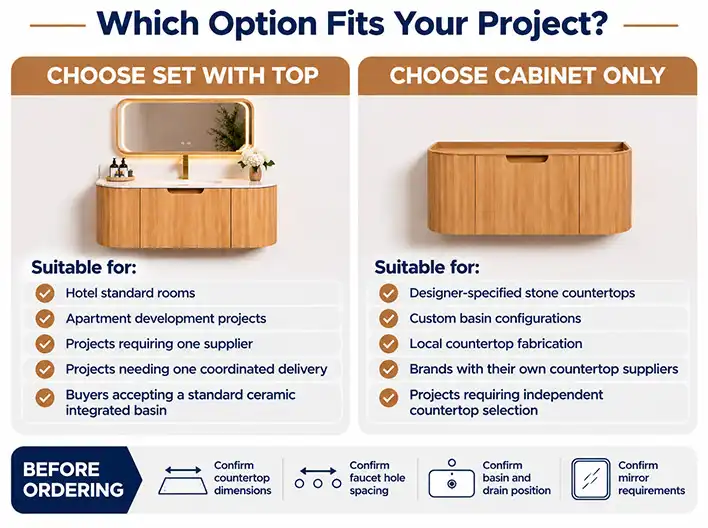
Table 4. Lines to align when comparing a with-top quote and a cabinet-only quote.
| Line | In a set quote | In a cabinet-only quote | What to add or confirm |
| Cabinet | Included | Included | Size, finish and hardware match |
| Top material | Included | Not included | Material, thickness, edge and weight |
| Basin | Included | Not included | Basin type and drain position |
| Faucet drilling | Drilled at the factory | None | Hole layout matches the faucet |
| Backsplash | Included, 100 mm | Not included | Height and material |
| Mirror | Included | Quoted separately | Type, width and functions |
| Packing | Stated in the quote | Stated in the quote | Shared box or separate boxes |
| Delivery terms | Same basis | Same basis | The same Incoterm and port on both |
For a wider project checklist, see the project and wholesale buying guide. A buyer who sources the top locally adds the top’s freight, the local fabrication and the fitting to the cabinet price, then compares that total with the set price.
Plywood suits a bathroom vanity when the panel grade, the edge sealing and the surface finish are all specified for a humid room. Plywood is not fully waterproof, so we seal its edges against moisture. The plywood vanity guide covers the grades and finishes.
A set with top is usually the better choice when one supplier specifies the top and mirror for a repeated layout, because it gives one quote and one delivery. A cabinet only suits a project where a designer or a local fabricator specifies the top. Compare the two on the same lines before deciding.
No. A cabinet only includes the cabinet, and the countertop, sink and faucet holes come with the top. In our set, the faucet holes are drilled at the factory, and none are drilled on site. The faucet and drain fittings are bought separately in both cases.
Yes, Dlinxcy can supply the cabinet alone, and the price depends on the top type. Send the supplier the top size, the overhang, the backsplash height and the faucet drilling, so the cabinet doors and drawers clear the top. Ask for a line-item price for each top option.
Whether a top can be removed depends on how it is fixed, so confirm the fixing method before ordering a replaceable top. Ask whether the top is glued or only set in place, and whether replacing it means removing the cabinet. Remodelers often ask this, because the answer differs between products.
Choose the set when one supplier specifies the top and mirror, and choose the cabinet only when another party does. Either way, compare the two quotes only after the top, basin, drilling, backsplash and mirror lines match.
Founded in 2007, Dlinxcy operates a 15,000 m² bathroom vanity factory in China with FSC-certified wood options. We manufacture multi-layer plywood cabinets alongside ceramic, man-made marble and sintered stone tops, LED mirrors and mirror cabinets for hotel projects, apartment blocks, contractors and wholesale brands. Whether you need complete vanity sets or cabinet-only units.
To request a line-item quote, send our team the following project details through the contact page:
Send Inquiry To Dlinxcy Experts