Contact Dlinxcy, Get Your Solutions!
Dlinxcy Supplies OEM & ODM Bathroom Vanity Sets, Bathroom Cabinet, LED Mirror, Mirror Cabinets Services for You. Contact us now for a Quote or Samples.
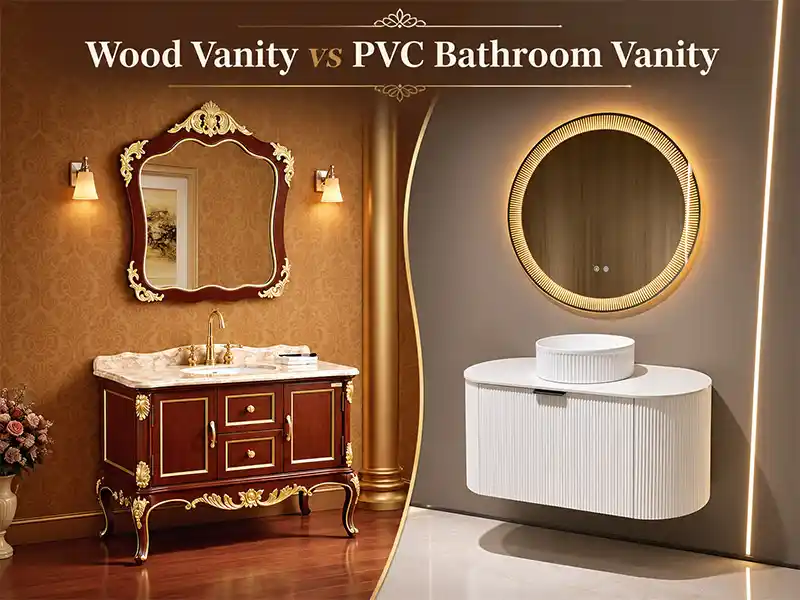
Choosing between a wood vanity and a PVC bathroom vanity? Focus on three things: direct water exposure, core construction, and finish.
For wet zones with frequent splashing, choose 15–18 mm Celuka (crusted) PVC board. Its solid PVC core is 100% waterproof and rot-proof. Before you buy, verify three things: board density, screw-holding strength, and heat clearance.
For dry or well-ventilated bathrooms, choose a plywood cabinet box with solid wood frames or doors. This option gives you natural wood grain, stronger screw grip, rigid support for heavy stone countertops, and refinishable surfaces. Make sure cut edges and sink joints stay sealed.
Check the box, doors, back, and fixings separately, because the visible finish does not identify the material underneath. See our Best Material for Bathroom Vanity Cabinet: Buying Guide.
Key takeaways
Table1: Quick comparison of solid wood, plywood cabinet, and Celuka PVC vanity in bathroom.
| Comparison factor | Solid wood parts | Plywood cabinet | Celuka PVC Bahtroom Cabinet |
| Direct water exposure | Sensitive to standing water; swells or shrinks across the grain | Cross-laminated veneers resist warping, though cut edges need sealing | 100% waterproof core; sink joints and mixed parts still need leak control |
| Screw grip & stone-top support | Strong screw grip; wide solid panels must allow seasonal movement | High structural stiffness and reliable screw holding for stone tops | Holds well at 0.55–0.70 g/cm³ density; wide spans and repeated screw removal need reinforcement |
| Local heat tolerance | Stable around everyday bathroom styling tools | Stable core; surface durability follows the veneer or paint system | Thermoplastic softens near local high heat above 55°C–60°C |
| Typical wear & repairability | Painted or stained lumber can be sanded and refinished | Hardware seats stay tight; chipped finishes or edges need prompt sealing | Core never rots, while scratched coatings or stripped screw holes need targeted repair |
| Relative cost tier (same spec) | Highest material and joinery cost | Mid-to-upper tier depending on veneer grade and paint process | Mid-to-upper tier for high-density crusted board; low tier for low-density foam board |
| US TSCA Title VI scope | Solid lumber is outside scope unless paired with composite-wood backs or drawers | Covered under hardwood plywood rules unless a listed exclusion applies | PVC board is outside scope, while any regulated wood back or drawer inside is covered |
| Best bathroom fit | Dry or well-ventilated bathrooms prioritizing solid wood doors and frames | Mainstream residential, hotel, and wall-hung vanities needing wood look and rigidity | Wet zones, open shower bathrooms, and high-splash rental or coastal projects |
A wood vanity can use solid lumber, a plywood cabinet, or both, while PVC can describe the board or only its surface. The useful comparison starts with the material in each part, because a waterproof face cannot protect an exposed wood core everywhere.
The cabinet box, also called the carcass, is the body that holds the doors, drawers, and countertop. A face frame is the framework across the front of that box. Doors and drawer fronts can use different materials from the sides or back. A wood veneer is a thin layer of real wood bonded to another material.
| Construction | Cabinet box and front | Surface | What changes the choice |
| Solid-lumber construction | Solid wood in the specified parts; the back and drawers still need identifying | Paint, clear finish, or stain with a protective finish | Wood movement and the repair method matter |
| Plywood-cabinet construction | Layered wood panels, sometimes paired with a solid wood frame or doors | Melamine finish, wood veneer, HPL laminate, or paint with sealed edge banding | Panel grade, edge-banding seal, and site cutouts govern moisture resistance |
| PVC-board construction | Rigid or foamed PVC in the specified panels | Paint, film, or the board surface | Fixings, unsupported spans, and heat exposure need attention |
| PVC-wrapped wood-based construction | A wood-based core under PVC film, often used for doors | A formed PVC surface, commonly called thermofoil | Damage or an open edge can expose the absorbent core |
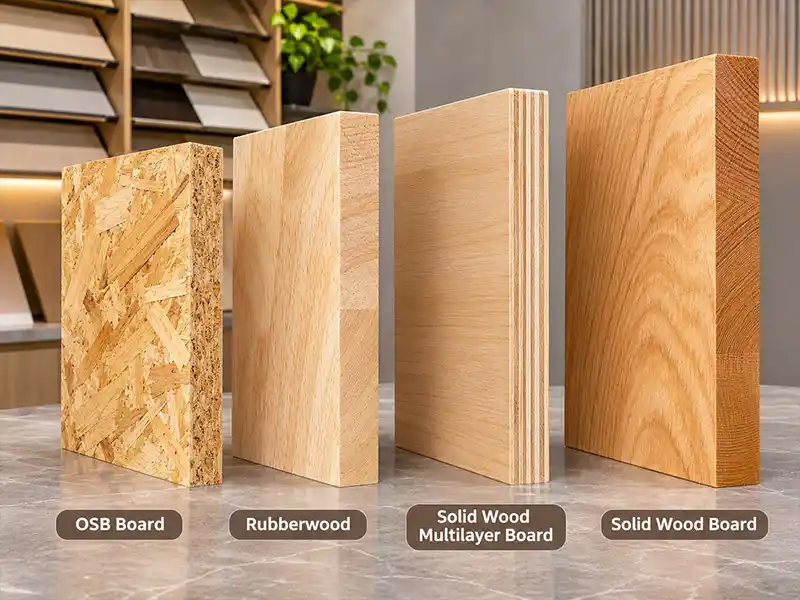
The table describes construction options, not a fixed bill of materials for every vanity. In bathroom manufacturing, solid wood bathroom cabinets are prone to warping or cracking due to humidity changes. Therefore, it is recommended it be stored in an environment with separate wet and dry areas.WPC, or wood-plastic composite, is another blend and should be named separately from PVC board.
Dlinxcy builds plywood vanity and high-density Celuka PVC vanity. For the wider three-material comparison, see our PVC, MDF, and plywood vanity guide.
Solid wood and plywood respond very differently to bathroom humidity. Although neither material has a waterproof core against standing water. Solid lumber expands and shrinks sharply across the grain as air moisture rises and falls, which can shift mitered joints or alter door gaps. Furniture-grade plywood stabilizes the cabinet box with cross-laminated veneers, and finishing the faces with thermally fused melamine plus sealed edge banding blocks everyday bathroom steam and surface splashes—leaving unsealed plumbing cutouts, screw holes, and damaged seams as the main water entry risks.
Wood cells exchange moisture with the air. Below the fiber saturation point, where the cell walls are saturated but their cavities contain no free water, moisture changes affect dimensions. Movement across the grain is much greater than movement along it. A wide solid panel therefore needs a construction that allows movement without forcing the joints apart.
The USDA Wood Handbook’s moisture chapter explains why paint, varnish, and lacquer slow moisture exchange without stopping it. Coating the face alone leaves cut edges, end grain, and damaged areas needing their own protection.
Plywood is a panel made by bonding thin wood veneers with their grain directions crossed. The cross-laminated construction described by APA helps resist warping and shrinkage. When paired with melamine-faced surfaces and machine-applied PVC or ABS edge banding, the sealed shell keeps daily surface splashes off the veneers, though cut wood layers still absorb water if an exposed edge or joint stays wet.
A vanity does not need every panel to be solid wood to suit a bathroom. A plywood panel with solid wood details can provide the wood appearance buyers want, while the panel layout helps control movement.
An oak door or birch veneer tells you about one part, not the whole cabinet. The more useful specification names the species, box material, finish, and treatment of edges together. A well-detailed plywood box can be a more practical choice than selecting an all-lumber cabinet only for its material label.
For a closer look at panel construction, use our plywood bathroom vanity selection guide. Keep the vanity’s location and wetting conditions in the decision, even when the wood species is familiar.
PVC vanity board is 100% waterproof, but the installed vanity still includes joints, hardware, and connections to other surfaces. Inspect the places where water can reach wood components or collect around fixings, not just the broad panel faces.
A plumbing leak can wet the cabinet from inside. Splashing can reach a door edge, and floor water can stay against a base panel. The same leak may leave a PVC panel usable while damaging a wood insert, a drawer part, or the surrounding wall. Material selection and leak control solve different problems.
| Exposure point | Wood-based construction | PVC-board construction | Useful action |
|---|---|---|---|
| Basin, countertop, and wall joints | Water can reach edges or the cabinet beneath | Water can bypass the panel and reach other parts | Check joints around the sink cutout and renew failed sealant |
| Plumbing openings in the back or base | Site cuts can leave the core exposed | A hole can still admit water into the cabinet or wall | Protect cut wood edges and leave plumbing access |
| Hinge and other fixing holes | Moisture can reach wood around the screw | The board resists water, but the fixing still needs a secure seat | Inspect the hardware and the material holding it |
| Bottom edges and floor contact | Standing water can keep an edge wet | Feet, fittings, or mixed-material parts remain exposed | Stop pooling and inspect the full base assembly |
| Damaged paint, film, or veneer | A break can expose the absorbent core | The finish can be damaged even when the board remains waterproof | Repair the finish using a compatible system |
The table is an inspection route, not a ranking of failure rates. On a sample, open the doors and look behind the drawers. A tidy front can hide a rough plumbing opening or a different back-panel material.
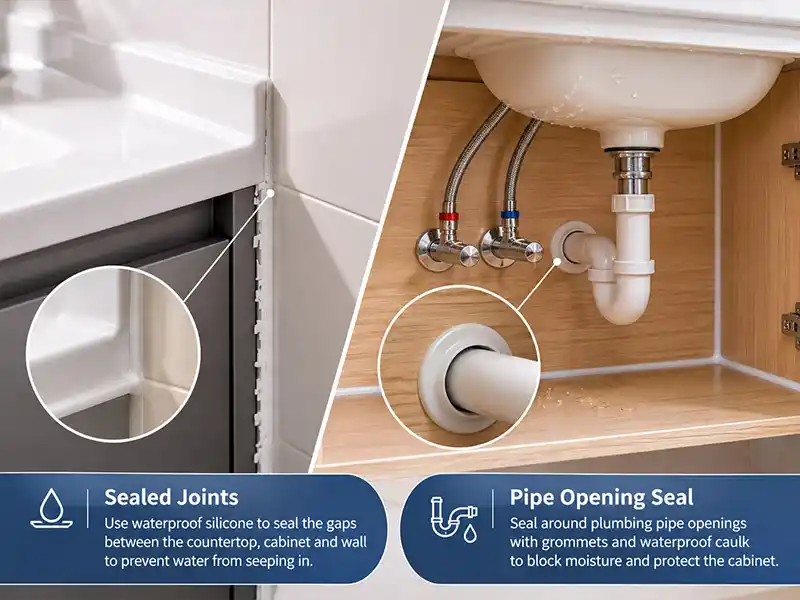
Moisture-resistant and waterproof are not interchangeable descriptions of a wood-based cabinet. Resistance to humid air or brief splashes does not mean an exposed core can tolerate standing water. PVC film over wood also leaves the core and cut edges part of the water-risk assessment.
A waterproof description also should not be read as a universal laboratory result of zero water absorption. Palram’s PALIGHT Premium physical-properties sheet lists 0.5% for its 3 mm sheet and 0.8% for its 10 mm sheet. Both values use ASTM D570 after 24 hours at 23°C. In everyday bathroom service, water trouble on a PVC vanity occurs when leaks bypass unsealed sink cutouts, corrode untreated hinges, or soak mixed-material wood drawers.
Protect a wood vanity by controlling leaks and standing water first, then treating exposed edges and openings. A new coating cannot repair an active plumbing leak or restore a swollen core to its original condition.
Use the finish maker’s repair instructions for chipped corners, raw cuts, and worn areas. At countertop and wall joints, use sealant compatible with the joined surfaces and the installation instructions. Keep the sink connections accessible, wipe up pooling water, and use bathroom ventilation to reduce prolonged dampness.
On new work, inspect site-made plumbing cuts before they disappear behind the drawers. Record which edges need protection and who completes that work. The factory finish and the installer’s cut edges belong in the same handover check.
In a ventilated bathroom with intact countertop seals, a well-built plywood or solid-wood vanity typically lasts 15 to 25+ years. A high-density PVC bathroom vanity commonly lasts 10 to 20+ years. Actual service life depends on box density, finish quality, hardware, and leak control because the two materials fail differently: wood-based vanities lose structural life if unsealed cutouts or base edges stay wet, whereas PVC panels never rot from water but fail early when low-density cores flex, coatings scratch, or hinge screws loosen.
Separate cosmetic wear from structural damage when deciding whether to repair or replace. A marked door may need refinishing, while a swollen fixing area may no longer hold hardware securely. A waterproof panel can remain intact even when a failed hinge or drawer slide makes the cabinet difficult to use.
Maintenance should follow the part that is deteriorating:
For a hotel or rental project, record which parts are replaceable without removing the whole vanity. Access to hinges, slides, and plumbing makes repairs easier to plan. A replaceable front also changes the cost of cosmetic damage.
Keep warranty terms separate from expected service life. A written warranty describes coverage and exclusions; it does not tell you when every cabinet will fail. Read the treatment of leaks, standing water, installation, and replacement parts alongside the stated coverage period.
PVC board is useful where wetting is frequent, but heat, unsupported spans, and repeated screw repairs need separate attention. Water resistance cannot tell you how a shelf will bend or how a wall-hung cabinet will carry its countertop.
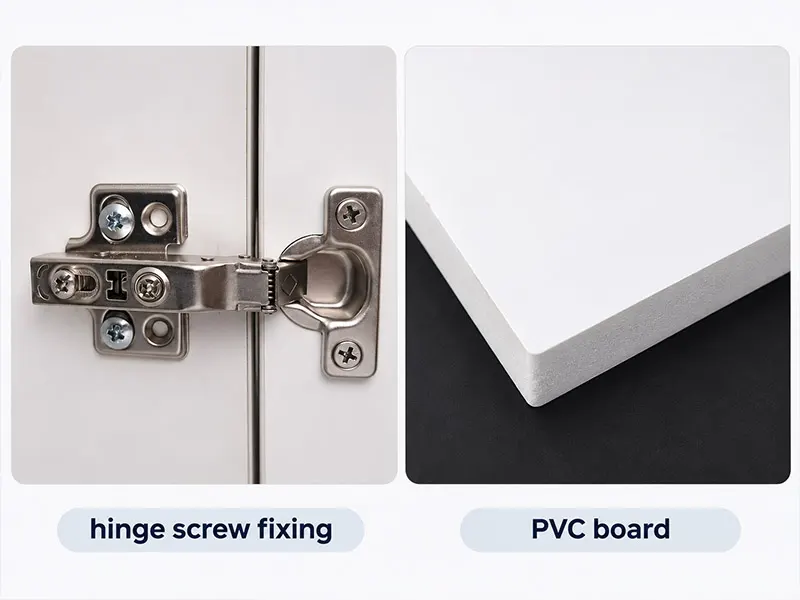
A foam board’s density and thickness affect its behavior, while the cabinet design determines where the load goes. The hinge screws, mounting rails, and countertop supports are therefore part of the material comparison. A general claim that one material is always stronger misses those details.
| Concern | Why it matters | Decision to make |
|---|---|---|
| Local heat | A thermoplastic panel can soften or distort | Keep hot tools off the panel and check the specified service-temperature range |
| Wide unsupported spans | The panel and joints must carry the stated load | Use a cabinet support layout rated for the actual countertop and stored items |
| Repeated screw removal | A damaged fixing hole can lose its secure grip | Use the maker’s repair detail or a specified reinforced connection |
Rigid cellular PVC panels typically carry a continuous service-temperature limit around 55°C to 60°C (for reference, the PALIGHT Premium sheet rates long-term service from −15°C to 55°C, distinct from short-term heat-deflection test values). Resting hot hair straighteners, curling irons, or uninsulated hot-water lines directly against a PVC cabinet panel can soften or distort the surface.
Screw-holding strength in a PVC cabinet depends directly on core density and pilot-hole accuracy. At Dlinxcy, our team find that loosened screws in PVC can be difficult to tighten securely again. Avoid repeated removal without a repair plan. Select any metal insert, backing piece, or revised fixing detail for the actual panel and load. Such changes are not universal cures for loose joints.
For a wall-hung unit, the wall fixing must transfer the cabinet and countertop load into suitable wall support. The wall substrate, backing, anchors, and cabinet hanging rail must work together as one rated support system.
US TSCA Title VI requirements follow regulated composite-wood parts, not the material name on the front of the vanity. A PVC cabinet containing a regulated plywood back or drawer component still needs those wood parts considered in its compliance documents.
For the US market, the EPA formaldehyde rule covers hardwood plywood, medium-density fiberboard (MDF), and particleboard, including finished goods containing these products. The rule includes labeling and third-party certification requirements.
Solid lumber and PVC board are not the three panel types in that definition. However, a cabinet described as solid wood can include a plywood back, and a PVC vanity can include wood-based drawer parts. Some structural plywood grades have specific exclusions, so the actual panel classification matters.
E0 or E1 wording alone cannot replace the TSCA Title VI information required for a regulated US product. Match the panel producer and supplied material to the documents; a certificate for an unrelated board is not useful. Do not use emission paperwork as a load rating or a waterproofing report.
At matching cabinet dimensions, drawer counts, and hardware grades, solid hardwood vanities cost the most. plywood vanities and high-density painted Celuka PVC vanities sit in a comparable mid-to-upper price tier. The low-density PVC boards or PVC-wrapped MDF cabinets cost the least. High-density crusted PVC board paired with multi-coat polyurethane painting often matches or slightly exceeds standard plywood box cost, while unusually cheap PVC quotes typically rely on thinner panels or low-density cores.
Compare wood and PVC quotations only after aligning every line item on both sheets: dimensions, door and drawer layout, exact panel thickness and density, surface finish, countertop and basin, hardware grade, packing, order quantity, and shipping terms. A cabinet-only price and a complete vanity set price answer different buying questions.
Dlinxcy plywood and Celuka PVC cabinet options use 15–18 mm structural boards, where both board thickness and finish complexity change the quotation. Full-extension drawer layouts also use more panels and slides than a basic two-door cabinet.
The better-value choice is the construction that meets your water exposure, countertop load, and market compliance requirements at a verified BOM specification, weighing hardware durability and finish upkeep alongside the purchase price. View our Plywood Bathroom Vanity Cost.
PVC’s material name alone cannot establish the health performance of a finished cabinet. The UK Environment Agency’s PVC-additives review separates rigid and plasticized PVC and explains that additive release depends on formulation and exposure conditions. Request product-specific chemical or emission documents appropriate to the destination market, including the coating and any wood-based parts.
A PVC vanity can support a stone countertop when the cabinet and support system are designed for that combination. Use the actual countertop weight, spans, rails, and wall or floor support in the assessment. A PVC sheet’s water-absorption result cannot establish the load rating of the assembled vanity.
Yes, wood and PVC can be combined when the joints and supports suit the materials. Dlinxcy offers plywood-and-PVC combinations. List the material for each component in the BOM, including hidden backing and drawers. Wood parts still need protection from wetting, even when the surrounding panels are waterproof PVC.
Repainting is possible when the existing finish and PVC substrate accept the chosen coating system. Follow the coating maker’s surface-preparation instructions and test adhesion on a small area first. Avoid using heat stripping as a general repair method, because PVC can distort. A damaged film may need a different repair from painted PVC.
Inspect hidden edges, drawer clearances, and fixing seats against the BOM. For a wood vanity vs PVC bathroom vanity comparison, review the sample with the specified countertop and mounting drawings. If it differs from the production quotation, record each difference and approve the production specification separately.
Both can be easy to clean when the finish is smooth and intact. A PVC vanity board resists water, but the coating may still be scratched or affected by an unsuitable cleaner. Use a soft cloth and a finish-compatible cleaner, then dry standing water. Check cleaner compatibility for the surface coating, edge banding, and hardware separately.
For the wood vanity vs PVC bathroom vanity decision, match the construction to water exposure and finish. PVC board suits frequent wetting; wood details and plywood construction offer options for a wood appearance. Judge repairs by the finish and replaceable parts, not the box material alone. Both need suitable countertop support and installation.
Send dimensions, quantities, mounting type, countertop choice, and destination market for a defined quotation. Start with Dlinxcy’s PVC vanity range or plywood vanity range and identify the required parts.
Send Inquiry To Dlinxcy Experts